


AI-powered digital farming advisors: key features & development costs
Digital farming advisors are one of the most important innovations in modern agriculture, helping producers make faster and more data-driven decisions in the face of rising complexity. Farms today operate under mounting pressure — volatile weather, increased input costs, labor shortages, and yield uncertainty — and the need for real-time insights is stronger than ever.

Digital farming advisors are one of the most important innovations in modern agriculture, helping producers make faster and more data-driven decisions in the face of rising complexity. Farms today operate under mounting pressure — volatile weather, increased input costs, labor shortages, and yield uncertainty — and the need for real-time insights is stronger than ever. Farmers no longer have days or weeks to evaluate field conditions; they need decisions now, and that’s where AI-powered advisory systems change the game.
The adoption curve reflects this shift. The AI in agriculture market is projected to reach USD 4.2 billion by 2028 (CAGR ~25%), driven by demand for automation, analytics, and intelligent crop support tools. Meanwhile, the global agriculture industry must increase food production by ~70% by 2050 to meet population growth, amplifying the need for decision support technologies.
Traditional reports and dashboards show what happened, but digital advisors go further — they analyze live field data, historical outcomes, weather forecasts, soil readings, and crop behavior to recommend what to do next. It’s a shift from reporting → advisory intelligence, where AI interprets patterns, predicts risk, and suggests actions instead of leaving humans to dig through spreadsheets or scouting logs manually.
With accelerating digitalization and rising AgTech maturity, AI-driven advisory platforms are transitioning from early adoption to mainstream utility, giving farms decision clarity, input efficiency, and competitive advantage.
What are AI digital farming advisors?
AI digital farming advisors are intelligent software systems that help farmers make agronomic decisions faster and more accurately. Think of them as a “ChatGPT-style assistant for agriculture” — but instead of general conversation, they analyze field data, weather forecasts, soil results, past performance, and agronomic research to deliver tailored recommendations for crop management. While traditional farm software shows charts and historical records, digital advisors interpret the data and suggest actions, bridging the gap between analytics and decision-making.
Unlike static dashboards that simply report results, AI farm advisory platforms are grounded in data models, agronomy expertise, and machine learning. They use multiple input streams such as:
– Soil test results and nutrient profiles
– Weather patterns, forecasts, and micro-climate data
– Satellite imagery and vegetation indices (NDVI, EVI)
– Machinery telematics and field activity logs
– Historical yield performance
– Crop genetics and hybrid recommendations
– Domain knowledge from research papers and agronomy guides
At their core, digital advisors combine data + algorithms + agronomic rules to answer questions like:
– Which hybrid is best for Field A this season?
-How much nitrogen should I apply next week?
-Should irrigation be increased due to upcoming heat stress?
This represents a fundamental evolution from traditional FMS dashboards, which require farmers to analyze data themselves. Instead of locating charts, comparing maps, or running spreadsheets, AI farm decision support systems deliver clear recommendations such as:
– Increase irrigation by 12% tomorrow to avoid stress.
-Hybrid B performs 18% better under high-clay soils.
-Disease risk rising — consider fungicide within 48 hours.
Digital advisors do not replace agronomists — they amplify decision-making, reduce uncertainty, and save time during critical windows. They function as an always-available assistant capable of processing terabytes of data faster than any human team.
How AI farming advisors work (under the hood)
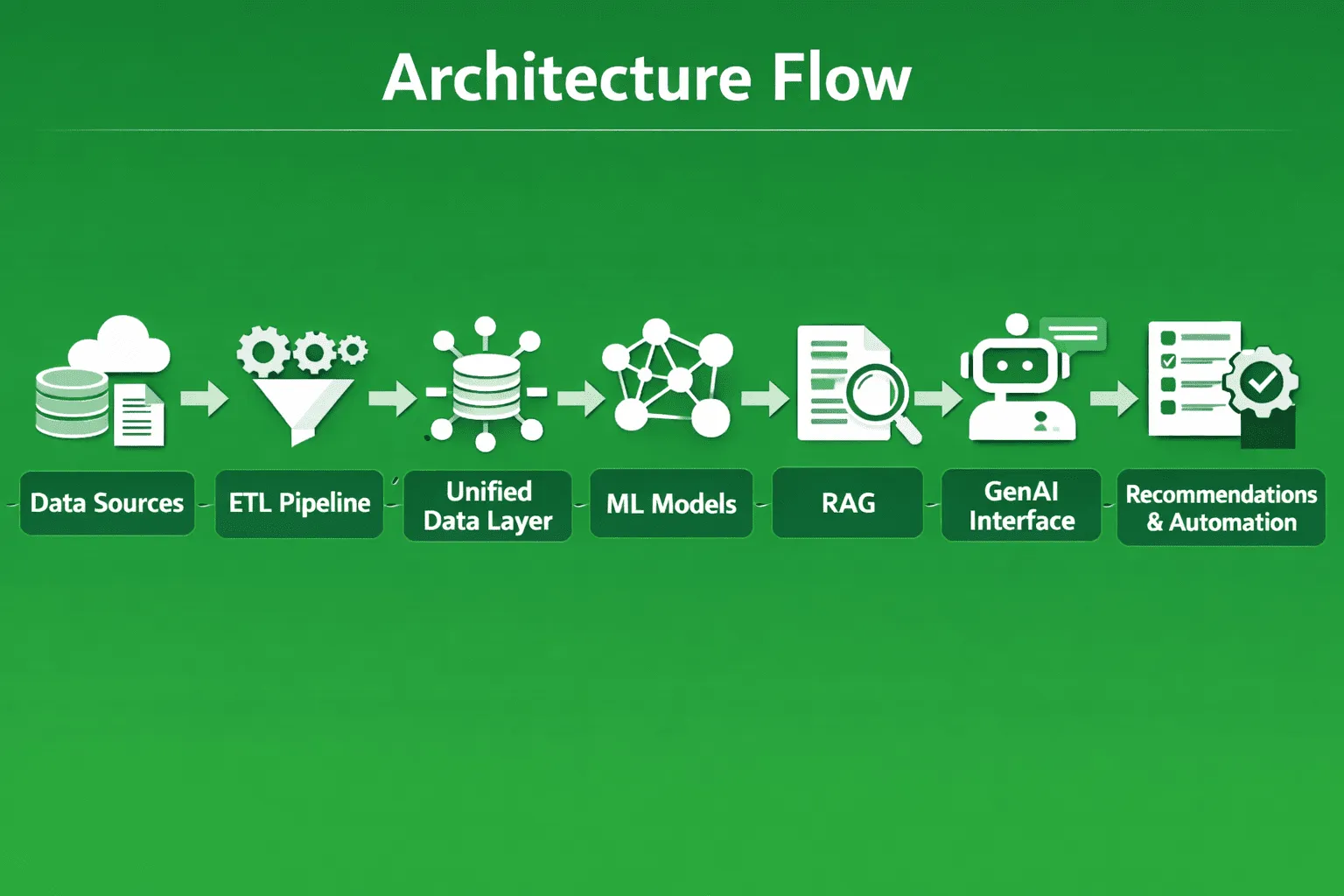
To understand the true power of digital farming advisors, it helps to look at how they work behind the scenes. These platforms aren’t just apps with charts — they operate as multi-layer AI decision systems capable of ingesting agricultural data, analyzing patterns, referencing agronomic knowledge, and producing actionable recommendations. Below is a breakdown of the core architecture that enables AI-powered farm advisory software to function.
Data ingestion layer — collecting information from the farm
The system first gathers raw data from multiple agricultural sources, including:
– IoT sensors (soil moisture, weather nodes, irrigation flow, etc.)
– Farm Management Systems (FMS) logs (planting dates, spray records, yield data)
– Soil test results and nutrient reports
– Weather APIs and climate forecasting data
– Satellite images (NDVI, EVI, biomass growth)
– Equipment telematics from tractors, combines, drones
This ingestion layer ensures digital farming advisors have up-to-date information about field conditions, making real-time monitoring and decision support possible.
Data processing & normalization layer
Raw agricultural data is often inconsistent or siloed. The platform runs ETL pipelines (Extract-Transform-Load) to:
– Clean and validate incoming data
– Convert units and formats (mm ↔ inches, kg/ha ↔ lb/acre)
– Align field boundaries and geospatial coordinates
– Unify multiple data sources into one schema
This normalization step is critical — without structured data, AI agriculture decision engines can’t produce reliable insights.
AI & machine learning model layer
Once data is unified, machine learning models analyze it to identify trends and make predictions. Common ML engines inside AI farm decision support systems include:
– Yield prediction models using historical and environmental trends
– Disease and pest risk detection based on humidity, crop stage & weather
– Nutrient optimization models for fertilizer rate decisions
– Anomaly detection to flag abnormal field behavior
– Cost/yield scenario simulations
ML improves over time — the more a system is used, the smarter its recommendations become.
RAG knowledge base (retrieval-augmented generation)
To provide expert-level insights, digital farming advisors often store:
– Research papers & agronomy manuals
– Compliance documentation
– Best-practice guides
– Crop variety catalogs and product data sheets
Using RAG (Retrieval-Augmented Generation), the AI can search internal documents and generate custom responses grounded in real agronomic knowledge instead of hallucinating.
Example query:
What is the optimal fungicide timing for wheat at GS 39 in humid conditions?
The advisor retrieves the information and answers confidently with evidence.
Generative AI interface — conversation with the farm
Instead of requiring farmers to navigate charts or build reports, modern digital farm advisors provide:
– Chat-style interfaces (ask questions like ChatGPT)
– Voice-enabled assistants for field use
– Mobile apps with offline mode
Farmers interact naturally — typing or speaking questions — and receive recommendations instead of raw data.
Decision recommendation engine
This is where insights turn into actionable instructions. After analysis, the system outputs prescriptive advice such as:
– Increase nitrogen by 15% in low-health zones next week.
– Spray fungicide within 48 hours — disease risk rising.
– Switch hybrid B for heavy clay fields — 13% higher yield potential.
Some systems even generate task lists, spray sheets, and VRA prescriptions automatically.
Core features of AI digital agronomy advisors
AI digital agronomy advisors go far beyond basic farm management software. Instead of only visualizing data, they help farmers decide what to do next — using machine learning, agronomic knowledge, and real-time field inputs. Below are the most common capabilities found across leading digital farming advisors and AI-based crop advisory platforms.
Yield prediction & scenario modeling
One of the most valuable features in AI-driven farm advisory systems is the ability to forecast yield outcomes under various management scenarios. Using weather patterns, soil data, hybrid behavior, and historical trends, the system can simulate:
– How yield changes if nitrogen rates increase
– Expected output with different hybrid/variety choices
– Loss potential under delayed irrigation or spray
This allows farmers to plan proactively rather than waiting for harvest to learn what worked.
Crop/variety selection recommendations
Digital advisors analyze multi-season yield maps, soil zones, disease history, and forecasted conditions to recommend the right hybrid or seed variety for each field. Instead of guessing, farmers get evidence-based suggestions tailored to local soil type and expected climate.
Example insight:
“Hybrid X outperformed Hybrid Y by 14% on high-clay soil in dry seasons.”
Fertilizer & chemical rate suggestions
AI agronomy engines can calculate optimal input rates per zone, improving profitability and sustainability. By comparing nutrient demand, crop stage, and previous response curves, the system recommends:
– Nitrogen application amounts
– Spray timing and active ingredient selection
– VRA (Variable-Rate Application) maps
This helps reduce overuse, cut costs, and limit environmental impact.
Weather & disease risk alerts
Real-time integrations with weather and disease models allow the system to warn farmers early, sending notifications such as:
– Rain expected → delay herbicide application
– High humidity → elevated fungicide risk window
– Heat stress forecast → adjust irrigation schedule
This is crucial for precision agriculture decision-making.
Field performance comparison
Farmers can compare fields, seasons, hybrids, and input programs side-by-side. Digital advisors highlight trends such as:
– Which field is most profitable
– Where yield loss is recurring
– Which zones respond best to fertilizer
This replaces guesswork with data-backed clarity.
Natural-language Q&A interface
Instead of digging into dashboards, farmers can ask questions conversationally:
“Why did Field 12 underperform last season?”
“When should I spray fungicide this week?”
The AI digital farming advisor retrieves relevant insights instantly — like having an agronomist available 24/7.
Mobile app + offline field mode
Because connectivity is not always reliable, leading tools include:
– Offline access for scouting and data entry
– Mobile-first workflows for field use
– Voice interactions for hands-free operation
AI support must work where farmers operate — in the field, not only at the desk.
Sustainability metrics & carbon impact insights
With carbon programs expanding, advisors increasingly calculate:
– Soil carbon gain potential
– Emission reduction impact
– Regenerative practice performance
– Sustainability reporting metrics
This is crucial for farms preparing for carbon markets and ESG compliance.
Spray & irrigation scheduling automation
For many farms, the timing of irrigation and chemical applications is just as critical as the rate. AI digital farming advisors help automate scheduling decisions by combining crop growth stage, weather forecasts, evapotranspiration levels, pest risk models, and soil moisture data. Rather than relying on intuition or calendar-based spraying, the system determines when to irrigate and spray for maximum effect.
Platforms with hardware integrations can connect directly to:
– Irrigation controllers
– Pivot systems
– Pump stations
– Autonomous sprayers and drones
Benefits include:
– Better disease suppression and pest control timing
– Up to 15–30% water savings with demand-based irrigation (validated across multiple irrigation optimization case studies globally)
– Increased chemical efficiency when applied during optimal temperature and humidity windows
– Reduced manual planning time for agronomists and advisors
– Lower input waste and environmental runoff
The result is smart, automated irrigation and spray management that protects yield and sustainability while minimizing costs and risk — a defining advantage of modern precision agriculture systems.
Who uses these solutions & who benefits
Digital farming advisors support decisions across the agricultural ecosystem, not just on the farm.
– Farmers gain faster decisions, optimized inputs, and higher ROI.
– Agronomists & crop consultants use AI insights to scale advisory services and reduce manual analysis.
– Ag input companies recommend products more accurately using data-backed prescriptions.
– Cooperatives & grain buyers forecast supply, manage quality, and streamline procurement.
– AgTech platforms enhancing FMS integrate advisory engines to differentiate and add premium features.
– Policymakers & sustainability programs track environmental impact and verify carbon outcomes.
In practice, these tools drive efficiency, lower risk, and measurable profitability while reducing time spent on data interpretation.
How digital farming advisors are built: tech & architecture
Behind the user-friendly interface, digital farming advisors operate on a modern AI architecture designed to collect, process, and analyze agricultural data at scale. A typical system consists of several technical layers working together to transform raw field information into real-time decisions.
Core technology components
Cloud backend (AWS, Azure, GCP)
Handles data storage, model deployment, and scalable processing for millions of data points per field.
IoT, satellite & API integrations
Connects sensors, weather platforms, soil labs, equipment telemetry, and remote sensing data for continuous farm monitoring.
Machine learning pipelines & data lakes
ETL workflows clean and standardize data, while ML models run yield prediction, nutrient forecasting, and anomaly detection.
GenAI + RAG knowledge layer
Retrieves agronomic documents, research, labels, and manuals to provide context-aware recommendations rather than generic answers.
Web & mobile interface
Farmers interact through dashboards, chat-style assistants, or mobile apps — often with offline field mode for remote operations.
Typical stack example
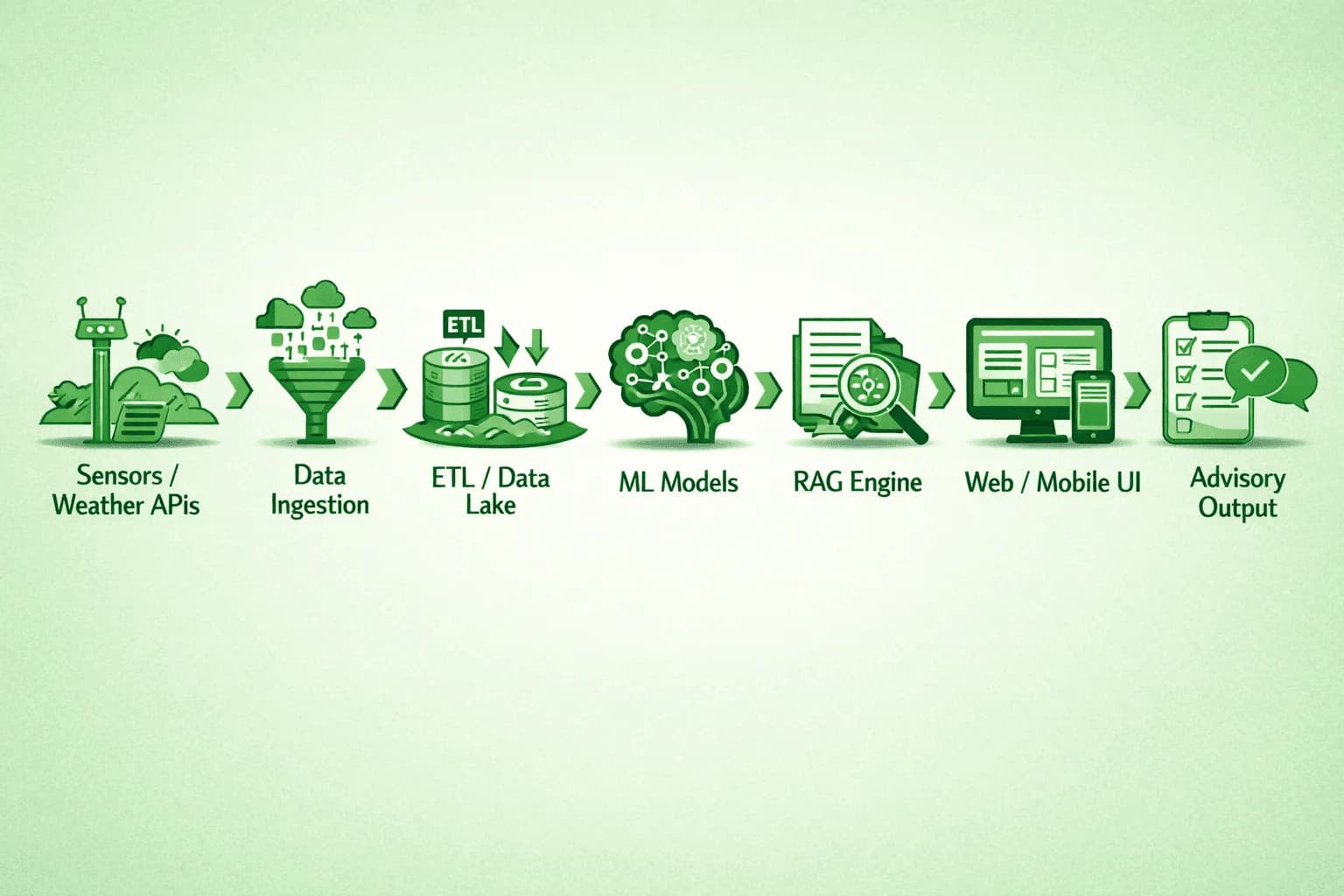
This architecture enables digital farming advisors to move beyond reporting and deliver actionable intelligence instantly, even at scale across large farms or cooperatives.
Development cost: how much does it cost to build an advisor like this?
Building digital farming advisors varies significantly in cost depending on scope, integrations, and AI complexity. While small prototypes can be developed quickly, production-ready platforms require robust infrastructure, data pipelines, UX design, and ongoing model training.
Estimated cost ranges
MVP / Prototype: $80K–$200K
Suitable for early testing — core features like chat interface, basic crop recommendations, limited data integrations, simple ML models. Ideal for pitching, pilots, or PoC deployments.
Full-scale production platform: $300K–$1M+
Includes advanced capabilities such as yield modeling, RAG knowledge base, IoT ingestion, weather APIs, variable-rate prescriptions, mobile app, offline mode, multi-region deployment, and data security layers.
Main cost drivers for building digital farming advisors
Factor | Impact on cost |
|---|---|
Number of data sources & integrations | More connections = higher engineering effort |
AI complexity (ML, RAG, predictive models) | Advanced modeling increases training time & cost |
Architecture scale (farm-level vs enterprise) | Multi-tenant cloud systems cost more |
Web + mobile experience design | UX for non-technical farmers requires refinement |
Compliance & security (GDPR/ISO/traceability) | Essential for enterprise-grade platforms |
Ongoing model retraining & maintenance | Long-term operational cost to maintain accuracy |
Pricing structure by product type
– SaaS AgTech product:
Requires scalable cloud architecture, subscription billing, admin dashboards, user onboarding → higher initial build + recurring maintenance.
– Enterprise custom solution:
Tailored to cooperatives/input companies with internal data systems → more integration-heavy, but fewer UI features needed.
– Internal advisory tool for agronomists:
Leaner interfaces, often built as a decision-support layer → mid-range development cost.
On average, early-stage AgTech companies begin with an MVP to validate adoption and expand gradually toward a full intelligence platform as datasets grow and models mature.
Challenges and considerations for building digital farming advisors
While digital farming advisory platforms offer immense value, their implementation comes with practical challenges that product teams and AgTech organizations must anticipate early.
Data quality dependency
AI recommendations are only as strong as the data behind them. Missing soil tests, inconsistent field boundaries, outdated weather inputs, or poor sensor calibration can lead to unreliable insights. A successful digital advisor depends on clean, structured, and continuous data flow.
Cold-start problem for first season
New systems lack historical data for model training. Until yield cycles, input history, and field patterns accumulate, recommendations may be limited. Many platforms overcome this by using public agronomy datasets, satellite history, and generalized crop models during onboarding.
Need for regional agronomy knowledge
Crop behavior varies by climate zone, soil type, and local practices. A model built for Midwest corn won’t perfectly serve Indian rice fields without adaptation. Localization is key — digital farming advisory systems must incorporate regional agronomy rules and crop-specific heuristics.
Regulatory & compliance considerations
Sustainability, carbon reporting, pesticide regulations, and data privacy mandates differ across regions. Compliance frameworks like GDPR, ISO security, traceability standards, and integrated record keeping must be addressed during development.
On-farm adoption barriers
Even the smartest system fails without farmer trust. Barriers include:
– Limited digital literacy in some regions
– Weak connectivity in rural areas
– Preference for human agronomists
– Resistance to automation replacing intuition
Successful adoption requires education, UX simplicity, offline work modes, and advisory transparency so users understand why the system recommends what it does.

Want to build your digital farming advisor?
Let’s do it in 4 weeks!
-card-640x480.webp&w=3840&q=75&dpl=dpl_2F3RrRGAaY33MNURi632dkspcWvZ)
-card-640x480.webp&w=3840&q=75&dpl=dpl_2F3RrRGAaY33MNURi632dkspcWvZ)
-card-640x480.webp&w=3840&q=75&dpl=dpl_2F3RrRGAaY33MNURi632dkspcWvZ)