Irrigation management software: features, benefits, and use cases
Water has become one of the most constrained and expensive inputs in modern agriculture — and irrigation decisions are no longer just agronomic, they are economic, operational, and regulatory. Across crop producers, specialty growers, permanent crop operations, vineyards, controlled-environment farms, irrigation contractors, and AgTech platforms, the same challenge keeps surfacing: manual, fragmented, or generic irrigation approaches can no longer keep up with scale, margin pressure, and water scarcity. This pressure is reflected directly in market dynamics. The MENA drip irrigation systems market alone is projected to grow from USD 306.2 million in 2024 to USD 1.2 billion by 2032, at a CAGR of 18.7%, driven by water stress, regulation, and the need for higher efficiency per hectare. At the same time, agricultural irrigation water use is forecast to rise, not fall. In Australia, for example, irrigation water usage is projected to increase 5.1% in 2024–25 to 4.1 megalitres per hectare, largely driven by water-intensive crops such as cotton and almonds.
What has changed is how irrigation is managed. Studies from 2024–2025 consistently show that smart irrigation technologies — including sensor-based systems, IoT platforms, AI-driven scheduling, and precision drip irrigation — deliver 20–50% water savings, while maintaining or improving yields through real-time data and automation.More advanced implementations go even further. Smart irrigation systems have been shown to conserve 30–50% more water than conventional approaches while increasing yields by up to 20% through precise scheduling, while IoT and AI platforms reduce water usage by up to 30% without yield loss, enabled by LPWAN and 5G connectivity for frequent data transmission.
By 2025, the market has clearly shifted away from standalone sensors toward hybrid systems combining sensor data, weather intelligence, predictive analytics, and emerging AI digital twins, delivering 20–46% efficiency gains and accelerating adoption across both agriculture and irrigation service businesses. The global smart irrigation market reached USD 2.5 billion, growing at 18.3% CAGR toward 2030, with acquisitions and platform consolidation accelerating innovation.
What is irrigation management software?
Irrigation management software is a digital system that helps agricultural and irrigation businesses plan, monitor, and optimize how, when, and where water is applied across fields, crops, or controlled environments. Instead of relying on manual schedules or isolated controllers, the software brings together data from irrigation infrastructure, sensors, weather services, and agronomic rules to support informed, consistent irrigation decisions.
In agriculture, irrigation management software acts as the coordination layer between water resources and crop needs. It enables growers and operators to manage irrigation and water management in agriculture more precisely by translating raw data—such as soil moisture, climate conditions, and crop stages—into actionable schedules and recommendations. This is especially critical in regions and operations where water availability, energy costs, and regulatory constraints directly affect profitability.
Modern irrigation management software goes beyond basic scheduling. Advanced platforms support precision irrigation management software capabilities, including real-time monitoring, automated control, predictive insights, and performance analytics. For irrigation businesses and service providers, irrigation business management software often extends these capabilities with operational tools such as multi-site management, reporting, and integration with existing farm or enterprise systems.
Ultimately, irrigation management software is designed to solve a core problem in agriculture irrigation: delivering the right amount of water at the right time, at scale, while reducing waste, controlling costs, and protecting long-term crop performance.
Key functions and features of irrigation management software
Modern irrigation management software combines operational control, agronomic intelligence, and data analytics into a single decision layer. While competitors often focus on individual features—such as scheduling or remote control—effective platforms bring these capabilities together to support scale, efficiency, and measurable outcomes across different agricultural operations.
1. Automated irrigation scheduling is the foundation. The software generates dynamic watering plans based on soil moisture levels, crop type, growth stage, weather conditions, and evapotranspiration data. Unlike static timers, these schedules continuously adjust as conditions change, helping operators avoid over- or under-irrigation while reducing water and energy consumption.
2. Real-time monitoring provides continuous visibility into irrigation systems and field conditions. By integrating soil moisture sensors, flow meters, pressure sensors, and controller data, the platform shows live system status, water usage, and anomalies across fields, zones, or facilities. This allows teams to detect issues early—before they impact crops or waste resources.
3. Remote control and centralized management enable users to manage irrigation operations from anywhere. Through web dashboards or mobile applications, operators can start or stop irrigation, adjust schedules, and control zones without being physically on-site. For multi-farm or multi-client operations, this centralized control is critical for consistency and scalability.
4. Advanced data analytics and diagnostics turn raw irrigation data into actionable insights. The software analyzes historical and real-time data to optimize water allocation, identify inefficiencies, and detect problems such as leaks, pressure drops, or clogged drippers. Over time, these insights support continuous improvement and more accurate planning.
5. Weather and forecast integration ensures irrigation decisions reflect real-world conditions. By incorporating local weather data—rainfall, temperature, wind, humidity, and forecasts—the system automatically adjusts irrigation plans to prevent unnecessary watering and respond proactively to changing conditions.
6. Zonal and field-level management allows precise control across diverse operations. Different crops, soil types, slopes, or microclimates can be configured as separate zones, each with its own irrigation logic. This is essential for farms, vineyards, orchards, and controlled environments where uniform watering leads to inefficiency or crop stress.
AI-enabled capabilities in irrigation management software
As irrigation operations scale and data volume increases, AI becomes the layer that turns monitoring into decision-making. AI-enabled irrigation management software goes beyond rule-based automation by learning from historical patterns, real-time conditions, and outcomes to continuously improve irrigation strategies.
1. Predictive irrigation planning uses machine learning models to forecast soil moisture dynamics, crop water demand, and stress risk days or weeks ahead. By combining historical irrigation data, weather patterns, crop stages, and soil behavior, AI helps operators anticipate irrigation needs rather than reacting after stress occurs.
2. Adaptive scheduling and self-optimization allows irrigation plans to evolve automatically. AI models evaluate the effectiveness of past irrigation decisions—such as yield response, water usage efficiency, or stress indicators—and refine future schedules without manual recalibration. This is especially valuable for specialty crops, permanent crops, and vineyards where optimal irrigation windows are narrow.
3. Anomaly detection and fault prediction enables early identification of system issues that are difficult to spot manually. AI can detect subtle deviations in flow rates, pressure patterns, or moisture response that indicate leaks, clogged emitters, valve failures, or sensor drift—often before visible crop damage or water loss occurs.
4. Decision support and recommendation engines translate complex data into clear actions. Instead of exposing users to raw metrics, AI-driven platforms provide prioritized recommendations such as when to irrigate, how much water to apply, and which zones require attention—supporting faster, more confident decisions for operators and managers.
5. Digital twin and simulation capabilities are emerging in advanced irrigation systems. AI-powered digital twins model irrigation infrastructure, fields, or controlled environments to simulate different irrigation scenarios and evaluate outcomes before execution. This helps teams test strategies, plan seasonal changes, and reduce operational risk.
6. Cross-site learning and portfolio optimization applies AI across multiple fields, farms, or clients. For farm management companies, irrigation contractors, and AgTech platforms, AI can identify patterns and best practices across operations, improving water-use efficiency and performance at scale.
Where irrigation management software delivers the most value
Irrigation management software is applied differently depending on the type of operation, but across agriculture irrigation and irrigation businesses, the goal is the same: improve control over water, cost, and outcomes. Below is how irrigation management software, precision irrigation management software, and irrigation business management software address the needs of different ICPs.
Crop producers (high-volume water users)
For large-scale agriculture irrigation systems, irrigation management software helps reduce water and energy costs by optimizing irrigation scheduling across extensive areas. It supports irrigation and water management in agriculture where regulatory compliance and consistent execution are critical, especially as water usage reporting becomes more strict.
Specialty crop producers
In high-value agriculture irrigation, yield consistency and crop quality are closely tied to irrigation accuracy. Precision irrigation management software supports tighter control over watering decisions, helping producers improve crop outcomes and achieve stronger ROI in operations with narrow margins.
Permanent crop operations
For orchards and other long-term crops, irrigation management in agriculture requires a long-term view. Irrigation water management software helps manage root-zone moisture more precisely, reducing cumulative water stress and supporting crop health across multiple seasons.
Vineyards and wineries
Vineyards rely on irrigation and water management for agriculture where water stress directly influences quality. Irrigation management software supports data-driven decisions at block or zone level, making it easier to manage irrigation practices consistently and justify investment in smart irrigation systems in agriculture.
Controlled environment agriculture (CEA)
In controlled environments, irrigation management software coordinates automated irrigation and fertigation using sensor-driven data. By integrating with agriculture irrigation systems and climate controls, it supports predictable production cycles and reduces manual intervention.
Farm management companies
For organizations managing multiple farms or clients, irrigation business management software provides centralized dashboards, multi-site visibility, and standardized reporting. This makes irrigation and water management in agriculture more transparent for owners, operators, and investors.
Irrigation contractors and integrators
Irrigation system installers and precision agriculture providers use irrigation business software as a value-added service. Irrigation management software enables centralized monitoring across customer sites, differentiation from competitors, and the foundation for recurring revenue through ongoing service and support.
AgTech and platform companies
For AgTech product companies, irrigation management software is often embedded rather than sold directly. Through white-label or integrated irrigation modules, farm management platforms, IoT hardware manufacturers, and precision ag startups accelerate time-to-market and differentiate their products within the irrigation management software market.
Across all these use cases, irrigation management software serves as the operational layer that connects agriculture irrigation systems, business processes, and data-driven decision-making—supporting more efficient, scalable, and resilient irrigation practices without unnecessary complexity.
Benefits of irrigation management software
Irrigation management software delivers value beyond basic automation by improving how water, energy, and operational decisions are made across agricultural and irrigation businesses. When implemented correctly, it creates measurable gains in efficiency, resilience, and long-term performance.
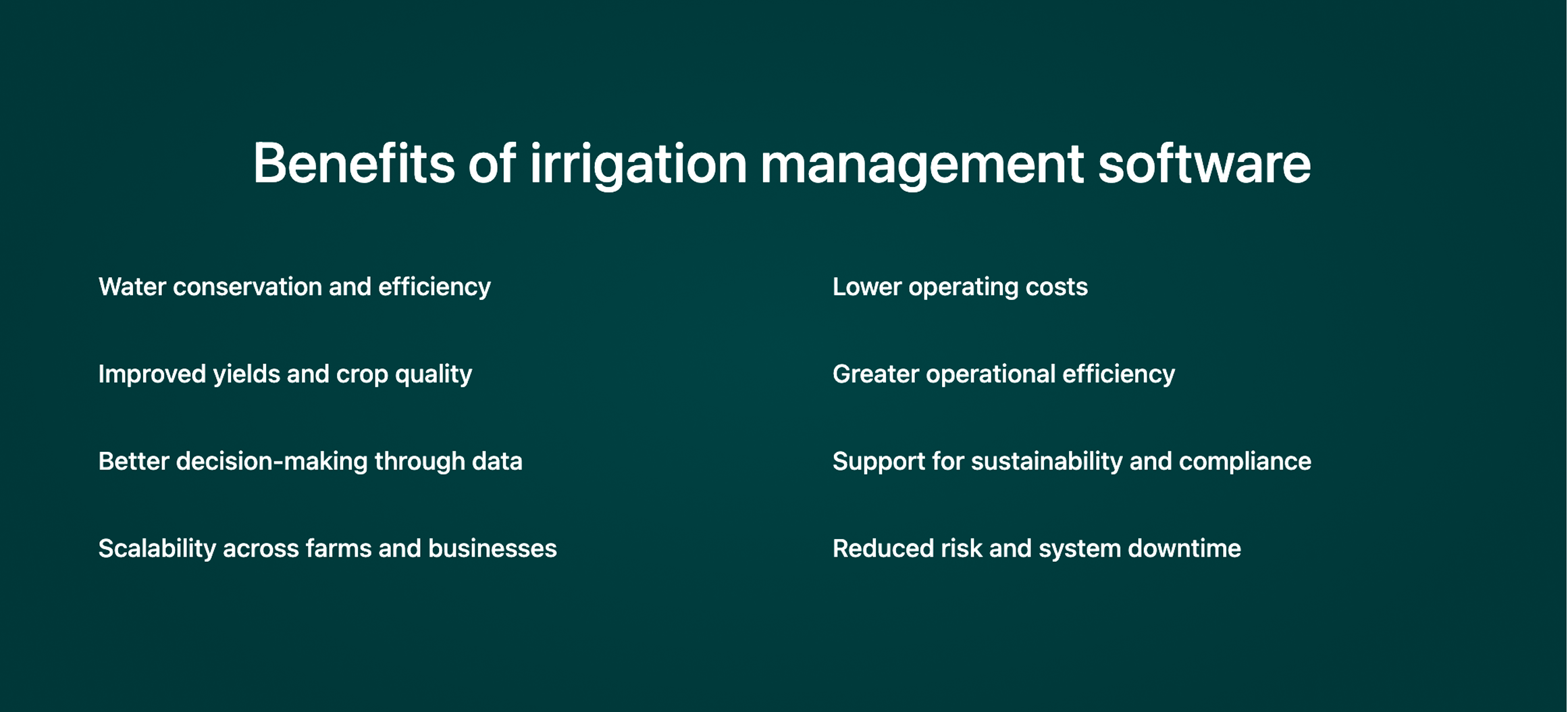
Water conservation and efficiency
By aligning irrigation schedules with real crop demand, soil conditions, and weather data, irrigation management software significantly reduces water waste. Precision irrigation management software helps ensure water is applied only where and when it is needed, supporting more responsible irrigation and water management in agriculture.
Lower operating costs
Optimized irrigation reduces direct water consumption, energy usage for pumping, and labor required for manual monitoring and adjustments. For large agriculture irrigation systems and irrigation businesses, these savings compound quickly across fields, zones, and seasons.
Improved yields and crop quality
Consistent irrigation decisions help prevent overwatering and underwatering, both of which stress plants and reduce performance. Irrigation management in agriculture supports healthier root systems, more uniform crop development, and better quality outcomes—especially for specialty crops, permanent crops, and vineyards.
Greater operational efficiency
Irrigation management software simplifies day-to-day operations by centralizing control, monitoring, and reporting. Automated scheduling, remote access, and zonal management reduce manual intervention and allow teams to manage larger or more complex operations without increasing workload.
Better decision-making through data
Access to real-time and historical data enables more informed irrigation decisions. Irrigation water management software provides visibility into usage patterns, system performance, and outcomes, supporting continuous optimization rather than reactive problem-solving.
Support for sustainability and compliance
As regulations around water use tighten, irrigation management software helps document usage, demonstrate efficiency, and align with sustainability goals. This is increasingly important for agriculture irrigation operations operating in water-stressed or highly regulated regions.
Scalability across farms and businesses
Whether managing a single operation or multiple sites, irrigation management software scales with growth. For farm management companies, irrigation contractors, and AgTech platforms, it supports consistent processes, standardized reporting, and portfolio-level oversight.
Reduced risk and system downtime
Early detection of anomalies such as leaks, pressure issues, or clogged emitters helps prevent water loss, crop damage, and unexpected downtime—reducing operational risk across irrigation systems.
Taken together, these benefits position irrigation management software not just as a control tool, but as a strategic component of modern agriculture irrigation—supporting efficiency, resilience, and long-term value in increasingly resource-constrained environments.
How irrigation management software works
At its core, irrigation management software acts as a coordination and decision layer between irrigation infrastructure, field conditions, and business objectives. It connects data sources—such as soil moisture sensors, weather services, flow meters, controllers, and farm management systems—into a unified platform that supports planning, execution, and continuous optimization of irrigation and water management in agriculture.
The process begins with data ingestion. The software continuously collects real-time and historical data from agriculture irrigation systems, including soil moisture levels, temperature, humidity, rainfall, evapotranspiration, system pressure, and water flow. This data is enriched with contextual inputs such as crop type, growth stage, soil characteristics, irrigation method (drip, sprinkler, micro-irrigation), and field zoning.
Next, the software applies irrigation logic and decision models. Rule-based logic, agronomic thresholds, and—in more advanced systems—AI-driven models evaluate the incoming data to determine irrigation needs. Precision irrigation management software calculates how much water is required, when it should be applied, and which zones or blocks need attention. Weather integration ensures irrigation plans adapt automatically to forecasted rain, heat, or wind conditions.
Once decisions are generated, execution and control take place. Through integrations with irrigation controllers and valves, the software can automatically start, stop, or adjust irrigation events. Remote control capabilities allow operators to override or fine-tune actions via web or mobile dashboards, supporting flexible management across multiple sites.
At the same time, monitoring and feedback loops remain active. The system tracks how fields respond to irrigation, monitors system performance, and flags anomalies such as leaks, pressure drops, or clogged emitters. This feedback is used to refine future irrigation schedules and improve water-use efficiency over time.
Finally, analytics and reporting transform irrigation activity into insight. Irrigation water management software aggregates performance data into dashboards and reports that support operational decisions, regulatory compliance, sustainability tracking, and business planning. For irrigation business management software use cases, this includes multi-site reporting, client-level visibility, and investor-ready summaries.
How it works — in simple terms
Irrigation management software gathers data from your fields, weather, and irrigation equipment, then uses that information to decide when and how much to water. It automatically adjusts schedules when conditions change, lets you control irrigation remotely, and shows you what’s happening across all your fields in one place. Over time, it learns what works best and helps you use less water while keeping crops healthy.
Simplified algorithm: how Irrigation management software operates
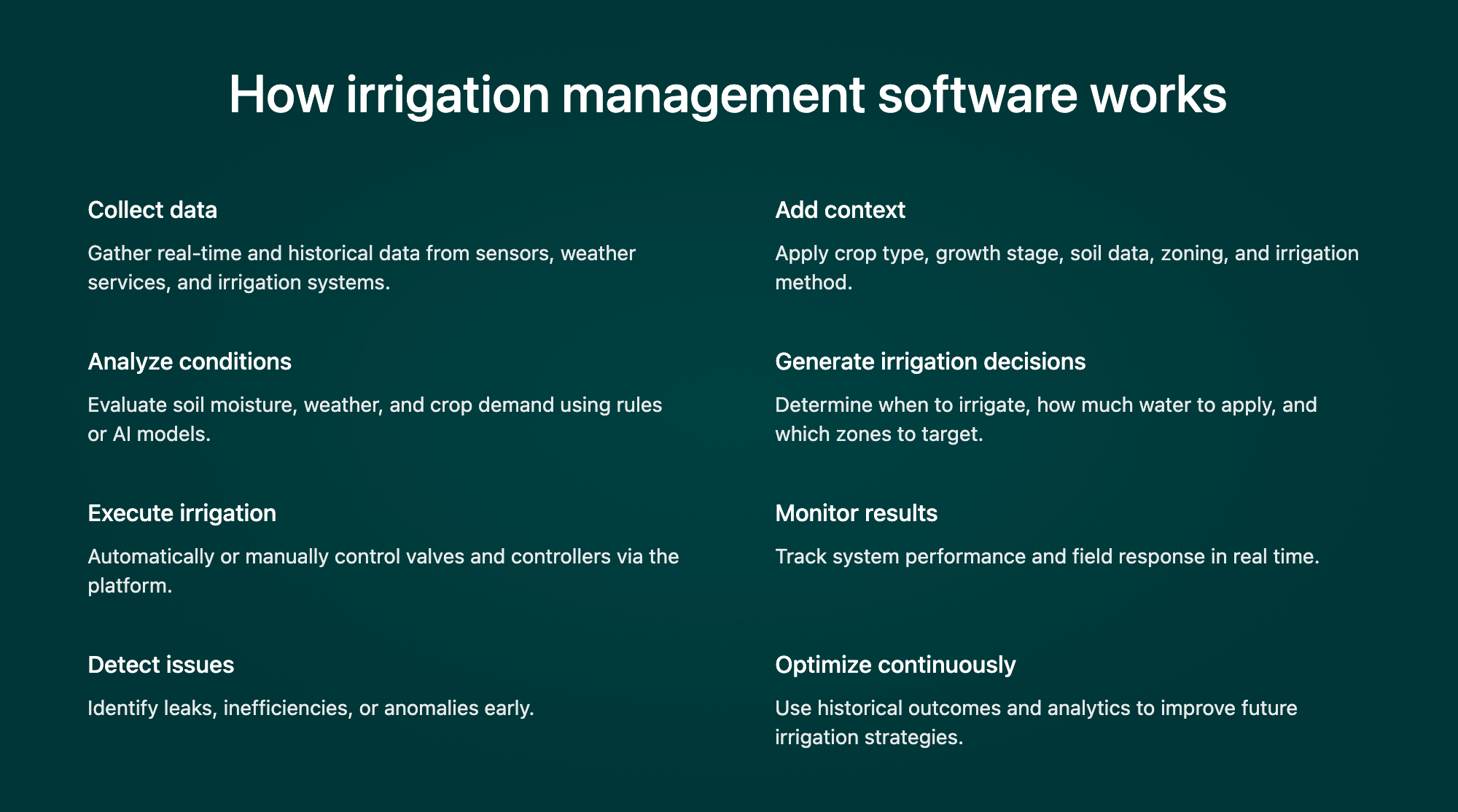
1. Collect data
Gather real-time and historical data from sensors, weather services, and irrigation systems.
2. Add context
Apply crop type, growth stage, soil data, zoning, and irrigation method.
3. Analyze conditions
Evaluate soil moisture, weather, and crop demand using rules or AI models.
4. Generate irrigation decisions
Determine when to irrigate, how much water to apply, and which zones to target.
5. Execute irrigation
Automatically or manually control valves and controllers via the platform.
6. Monitor results
Track system performance and field response in real time.
7. Detect issues
Identify leaks, inefficiencies, or anomalies early.
8. Optimize continuously
Use historical outcomes and analytics to improve future irrigation strategies.
This closed-loop process is what enables irrigation management software to move from basic control to consistent, scalable, and data-driven irrigation management in modern agriculture.
Core features of irrigation management software
Effective irrigation management software combines field-level control, real-time data, and decision intelligence to support efficient irrigation and water management in agriculture. Rather than focusing on a single capability, modern platforms bring together multiple functional layers to manage water use, crop health, and operational complexity.
Sensor and data integration
The software connects to a wide range of data sources across agriculture irrigation systems, including soil moisture sensors, temperature probes, EC (salinity) sensors, rain gauges, flow meters, pressure sensors, and irrigation controllers. This unified data layer provides accurate, real-time visibility into field conditions, system performance, and water usage.
Automated scheduling and adaptive control
Using sensor inputs, weather data, and crop-specific parameters, irrigation management software automatically creates and adjusts irrigation schedules. Precision irrigation management software continuously adapts watering plans based on changing conditions, helping ensure optimal application without manual recalibration. Control extends to pumps, valves, and zones, supporting consistent execution at scale.
Precision irrigation and water optimization
By aligning irrigation decisions with actual crop demand, the software reduces water waste while maintaining or improving crop performance. It supports precise irrigation and water management in agriculture by accounting for soil variability, crop stage, and microclimates, rather than applying uniform watering across entire fields.
Real-time monitoring and alerts
Continuous monitoring tracks irrigation activity and system health in real time. The platform generates immediate alerts for issues such as leaks, pressure drops, blocked emitters, abnormal flow rates, or equipment malfunctions, enabling faster response and reducing the risk of crop damage or water loss.
Predictive analytics and decision support
Advanced irrigation management software analyzes historical performance, real-time data, and weather forecasts to anticipate irrigation needs. Predictive models help optimize schedules, identify inefficiencies, and support more proactive decision-making compared to rule-based systems alone.
Fertigation and nutrient management support
For operations using fertigation, the software incorporates EC and nutrient data into irrigation logic. This allows coordinated water and nutrient application, improving uptake efficiency while reducing excess fertilizer use and environmental impact.
Business and operational management capabilities
For irrigation businesses and larger agricultural operations, irrigation business management software adds operational oversight. Features include centralized dashboards, zone and asset tracking, task coordination, and standardized workflows that support multi-site or multi-client environments.
Reporting, analytics, and compliance
Built-in analytics and reporting tools track water usage, efficiency metrics, and system performance over time. These capabilities support regulatory compliance, sustainability reporting, and data sharing with owners, investors, or regulators.
Integrations and technology stack
Irrigation management software integrates with farm management platforms, satellite imagery, weather services, IoT infrastructure, and irrigation controllers. API-driven architectures allow data exchange across systems, supporting broader digital agriculture and irrigation supply ecosystems.
Mobile and field access
Mobile and web access enable operators and field teams to monitor systems, receive alerts, and manage irrigation activities from anywhere. This improves responsiveness, reduces manual coordination, and supports more efficient field operations.
Taken together, these core features position irrigation management software as more than a control tool—it becomes the operational and decision backbone for modern agriculture irrigation, balancing water efficiency, crop performance, and business requirements at scale.
Feature comparison: basic vs advanced irrigation business management software
| Capability Area | Basic Irrigation Software | Advanced Irrigation Management Software |
|---|---|---|
| Data Inputs | Weather data, manual inputs | Soil moisture, EC, flow, pressure, weather, crop data |
| Scheduling | Static or rule-based schedules | Adaptive, AI-assisted, crop-specific scheduling |
| Control | Manual or limited automation | Full automation of pumps, valves, zones |
| Monitoring | Periodic status checks | Real-time system & field monitoring |
| Alerts | Basic notifications | Predictive alerts (leaks, pressure, failures) |
| Analytics | Historical usage reports | Water, energy, yield, and efficiency analytics |
| Zonal Management | Limited | Fine-grained, block/zone-level logic |
| Compliance | Manual reporting | Automated regulatory & sustainability reporting |
| Scalability | Single site | Multi-site, multi-client, portfolio-level |
| Integrations | Limited or none | Farm systems, IoT, satellite, APIs |
| Business Layer | Not included | Dashboards, asset tracking, reporting |
| AI & Optimization | Not available | Predictive models, optimization, digital twins |
Build & maintain your irrigation software management with Qaltivate
What sets Qaltivate apart is not a single feature or framework, but the combination of deep technology expertise and real understanding of agriculture—a mix that is still rare in the AgTech market.
We are a team of engineers who work specifically at the intersection of software and agriculture. That means we don’t treat irrigation, farm operations, or water management as abstract technical problems. We understand how agricultural processes actually work in the field—and how technology needs to fit into them without disrupting operations or creating complexity that teams won’t adopt.
Our perspective is shaped not only by delivery work, but by continuous industry dialogue. Through the Digital Ag Global podcast, we regularly host specialists, practitioners, and technology leaders from the agriculture sector to discuss critical challenges and emerging trends in AgTech. These conversations directly inform how we design, build, and advise on real-world irrigation and agricultural software solutions.
Beyond development, we work closely with AgTech startups, agricultural producers, irrigation businesses, and platform companies as a consulting partner. We help teams:
1. Move from fragmented or outdated systems to modern, data-driven and AI-powered solutions
2. Define what should be built—and what should not—before budgets are committed
3. Avoid common pitfalls that lead to expensive but underused technology
4. Align software architecture with long-term operational and business goals
From a delivery standpoint, we are a flexible and execution-focused team. We don’t require long onboarding cycles or extended setup phases. We can start work quickly and scale the team based on real project needs—whether that involves backend engineers, GIS specialists, IoT developers, or ML/AI engineers. This allows projects to move forward without delays caused by staffing or organizational overhead.
In practice, this means clients work with a partner who understands both how agriculture operates today and how technology should evolve it responsibly—without overengineering, wasted budgets, or solutions that look good on paper but fail in the field.
Build vs. buy considerations for irrigation management software
Deciding whether to buy an off-the-shelf solution or build a custom irrigation management platform is rarely a purely technical choice. In irrigation and water management for agriculture, the decision usually depends on scale, operational complexity, and how closely irrigation performance is tied to business outcomes.
Below are common operational scenarios where this decision typically plays out differently.
When irrigation spans large areas and multiple crops
Basic scheduling and monitoring tools may be sufficient at an early stage. As operations expand across many fields, crop types, and regulatory zones, generic platforms often struggle to support multi-field optimization, energy cost analysis, and structured compliance reporting. In these cases, customization becomes necessary to maintain control and consistency at scale.
In operations where crop quality directly impacts profitability
Standard automation tools can handle timing and volume, but they rarely reflect crop-specific logic or quality-driven decision requirements. Where yield consistency and product quality are core business drivers, tailored irrigation logic and optimization models offer greater long-term value than fixed, generic workflows.
In perennial and long-term crop systems
Irrigation decisions in these environments accumulate over years rather than weeks. Software designed around short irrigation cycles often lacks support for long-term moisture modeling, seasonal automation, and historical trend analysis. Custom or extended platforms are better suited to managing irrigation strategies that protect long-term crop health.
In quality-driven, block-based production environments
Some production systems require deliberate water stress management and block-level decision-making. While off-the-shelf solutions may provide basic control, they often fall short when irrigation needs to align with quality metrics rather than generic thresholds. Custom development allows irrigation logic to reflect these more nuanced requirements.
In tightly controlled growing environments
Where irrigation is tightly integrated with climate, lighting, and fertigation systems, partial platform support can create operational gaps. Building or extending irrigation software enables full automation, real-time orchestration, and API-level integration across systems that need to work together continuously.
In multi-site or portfolio-based operations
Managing irrigation across multiple locations, operators, or clients introduces challenges that single-site tools are not designed to handle. Centralized dashboards, role-based access, standardized reporting, and portfolio-level visibility are often easier to achieve through custom or heavily adapted solutions.
In service-driven irrigation delivery models
Organizations managing irrigation systems for multiple customers often find that third-party platforms limit differentiation. Building white-label or proprietary software allows greater control over system integration, service models, and the creation of recurring revenue rather than relying solely on project-based work.
In product platforms where irrigation is an embedded capability
When irrigation functionality is part of a broader software product, buying standalone tools is rarely sufficient. Embedded modules, API-first architectures, and custom decision logic are typically required to align irrigation capabilities with existing platforms and accelerate time-to-market without sacrificing differentiation.
Many organizations begin by buying software to validate processes, then transition toward building or customizing as operational complexity grows. The key is avoiding overinvestment early, while also avoiding tools that become constraints as requirements evolve.
In irrigation management in agriculture, the most effective approach is often to build selectively, buy where it makes sense, and design systems that can evolve rather than be replaced.
How we work
For startups and growing AgTech companies
1. We help startups build focused, purpose-driven irrigation software without overengineering early-stage products.
2. We integrate quickly with available sensors, IoT devices, and third-party platforms to accelerate time-to-market.
3. We design modular, cloud-native architectures that can evolve from MVP to production without rework.
4. We apply practical agricultural insight to ensure technology solves real field problems, not just technical ones.
For enterprise organizations
1. We build custom irrigation management software designed to fit complex, large-scale agricultural operations, rather than forcing enterprises into rigid off-the-shelf tools.
2. We integrate with existing infrastructure, including hardware controllers, sensors, legacy platforms, and enterprise systems, without disrupting ongoing operations
3. We design secure, scalable, cloud-ready architectures that support multi-site, multi-region deployments and long-term growth.
4. We align software logic with real agricultural processes and business constraints, supporting compliance, reporting, and operational continuity.