
Vibe Coding Services for AgTech: Build Agricultural Software Faster with
The agriculture industry has no shortage of innovative ideas.
Farmers want AI assistants that answer questions about crop health in seconds. Agronomists need smarter decision-support systems. Equipment manufacturers are looking for connected platforms that integrate data from machines, sensors, and satellites. Agribusinesses want to automate repetitive workflows, improve forecasting, and make better decisions based on real-time information.
The challenge isn’t generating ideas—it’s turning them into software before the opportunity passes.
Traditional software development often requires months of planning, coding, testing, and revisions before users can interact with the first working version. By that time, market priorities may have changed, growing seasons may have ended, or investors may be waiting for tangible progress.
This is where Vibe Coding is changing software development.
Instead of manually writing every line of code, experienced software engineers collaborate with AI coding assistants such as Claude Code, Cursor, GitHub Copilot, OpenAI Codex, Lovable, and other modern AI development tools. These assistants accelerate coding, documentation, testing, and prototyping, allowing engineering teams to deliver software significantly faster while maintaining professional engineering standards.
At Qaltivate, we don’t replace developers with AI—we make experienced AgTech engineers dramatically more productive using AI-assisted development. The result is faster MVP delivery, shorter feedback cycles, and production-ready agricultural software built on years of engineering and agriculture expertise.
FREE GUIDE TO VIBE CODING FOR BEGINNERS
What is vibe coding?
Vibe Coding is an AI-assisted software development approach where developers collaborate with intelligent coding assistants throughout the entire development process.
Instead of spending hours writing repetitive code manually, developers describe what they want to build, review AI-generated solutions, improve them through prompts, and continue refining the application until it meets production standards.
The workflow typically looks like this:
Developer → AI → Developer Review → AI Improvements → Production Software
Or, in simpler terms:
Business Idea
↓
Claude or another AI assistant
↓
Working code
↓
Testing
↓
Improved prompts
↓
Production-ready application
The important distinction is that AI never replaces the engineer.
The engineer defines the architecture, validates every decision, reviews security, integrates business logic, and ensures the software is scalable and maintainable.
The term Vibe Coding became widely recognized after AI researcher Andrej Karpathy described the experience of collaborating naturally with AI coding assistants rather than manually writing every implementation detail.
Vibe Coding vs No-Code vs Low-Code
Many people confuse these concepts, but they solve different problems.
| Approach | Best For |
|---|---|
| No-Code | Simple websites, forms, and internal workflows without programming |
| Low-Code | Business applications built with visual components and limited custom coding |
| Vibe Coding | Professional custom software where experienced engineers use AI to accelerate development |
Unlike no-code platforms, Vibe Coding doesn’t limit what you can build. Developers still create fully customized software—AI simply helps them build it faster.
Why vibe coding matters for agriculture
Agriculture is one of the most technology-intensive industries today.
Modern farms rely on satellite imagery, IoT sensors, GPS guidance, weather forecasting, machine telemetry, remote sensing, AI recommendations, compliance reporting, and ERP integrations.
Building software that connects all these systems traditionally requires significant engineering effort.
With Vibe Coding services, development becomes dramatically faster.
This approach is particularly valuable for:
- Farm Management Systems
- Crop Monitoring Platforms
- Precision Agriculture applications
- Livestock management software
- Field scouting applications
- Irrigation management platforms
- Carbon farming solutions
- Grain trading systems
- AI agronomy assistants
- Satellite analytics dashboards
Instead of waiting eight or more months before seeing a working application, companies can often validate ideas with functional prototypes within weeks.
That speed matters because agriculture doesn’t pause.
Growing seasons don’t wait for software.
Planting windows don’t shift because development is delayed.
The faster stakeholders can test software with real users, the sooner they can improve workflows and create measurable business value.
How vibe coding works (without technical jargon)
ou don’t need to understand programming to understand the development process.
Here’s how AI-assisted software development typically works.
Step 1. Define the business idea
Everything starts with a business problem rather than technology.
For example:
“We want farmers to receive irrigation recommendations automatically.”
Step 2. Gather requirements
The team defines:
- who will use the software
- what information they need
- existing systems to integrate
- desired business outcomes
Step 3. AI generates the first version
Engineers work with Claude Code, Cursor, or other AI tools to rapidly generate application components, APIs, interfaces, documentation, and automated tests.
Step 4. Engineers review everything
Every generated component is reviewed for:
quality
performance
scalability
security
maintainability
Nothing goes into production without human approval.
Step 5. Testing
The software is tested with real agricultural workflows, ensuring recommendations, calculations, integrations, and user interfaces perform correctly.
Step 6. Production deployment
After validation, the application is deployed to the cloud, integrated with existing systems, and continuously improved based on user feedback.
Where vibe coding works best in AgTech
| Great for | Less suitable without engineering vversight |
|---|---|
| MVP development | Enterprise ERP replacements |
| Dashboards | Mission-critical infrastructure |
| Mobile applications | Highly regulated systems |
| Internal business tools | Safety-critical automation |
| AI assistants | Large-scale legacy modernization |
Vibe coding delivers the greatest value when organizations want to validate ideas quickly while maintaining professional software engineering practices.
Benefits of vibe coding services
Faster MVP development
Building an MVP is no longer about waiting months before users see the first version.
AI-assisted development dramatically accelerates coding, allowing engineering teams to spend more time refining business logic instead of repetitive implementation work.
This means investors, customers, and stakeholders can interact with real software earlier.
Lower development costs
AI reduces repetitive engineering effort, enabling development teams to accomplish more within the same timeframe.
Rather than replacing developers, AI allows experienced engineers to focus on high-value decisions while automation handles routine coding tasks.
Faster validation
The sooner users interact with software, the sooner valuable feedback is collected.
Instead of discovering issues after months of development, companies can iterate continuously.
Better collaboration
AI-generated documentation, diagrams, and prototypes make communication easier between technical and non-technical stakeholders.
Everyone can understand the product vision earlier.
Easier experimentation
Trying new ideas becomes significantly less expensive.
Organizations can test multiple concepts before committing to large development budgets.
More innovation
When engineering teams spend less time on repetitive coding, they can focus on solving meaningful agricultural challenges and exploring innovative AI capabilities.
Continuous improvement
AI also accelerates future updates.
Adding new features, integrations, and reports becomes faster because development workflows remain highly automated.
Real examples of agricultural software that can be built faster
At Qaltivate, we’ve seen AI-assisted development significantly accelerate projects such as:
- AI Agronomy Assistants
- Crop Monitoring Platforms
- Precision Irrigation Dashboards
- Farm Operations Assistants
- Machinery Data Hubs
- Livestock Monitoring Systems
- Carbon Farming Platforms
- Grain Trading Dashboards
- Remote Sensing Analytics Platforms
- Farm Management Systems (FMS)
These applications often combine GIS data, satellite imagery, IoT devices, AI recommendations, cloud infrastructure, and third-party APIs into one integrated platform.
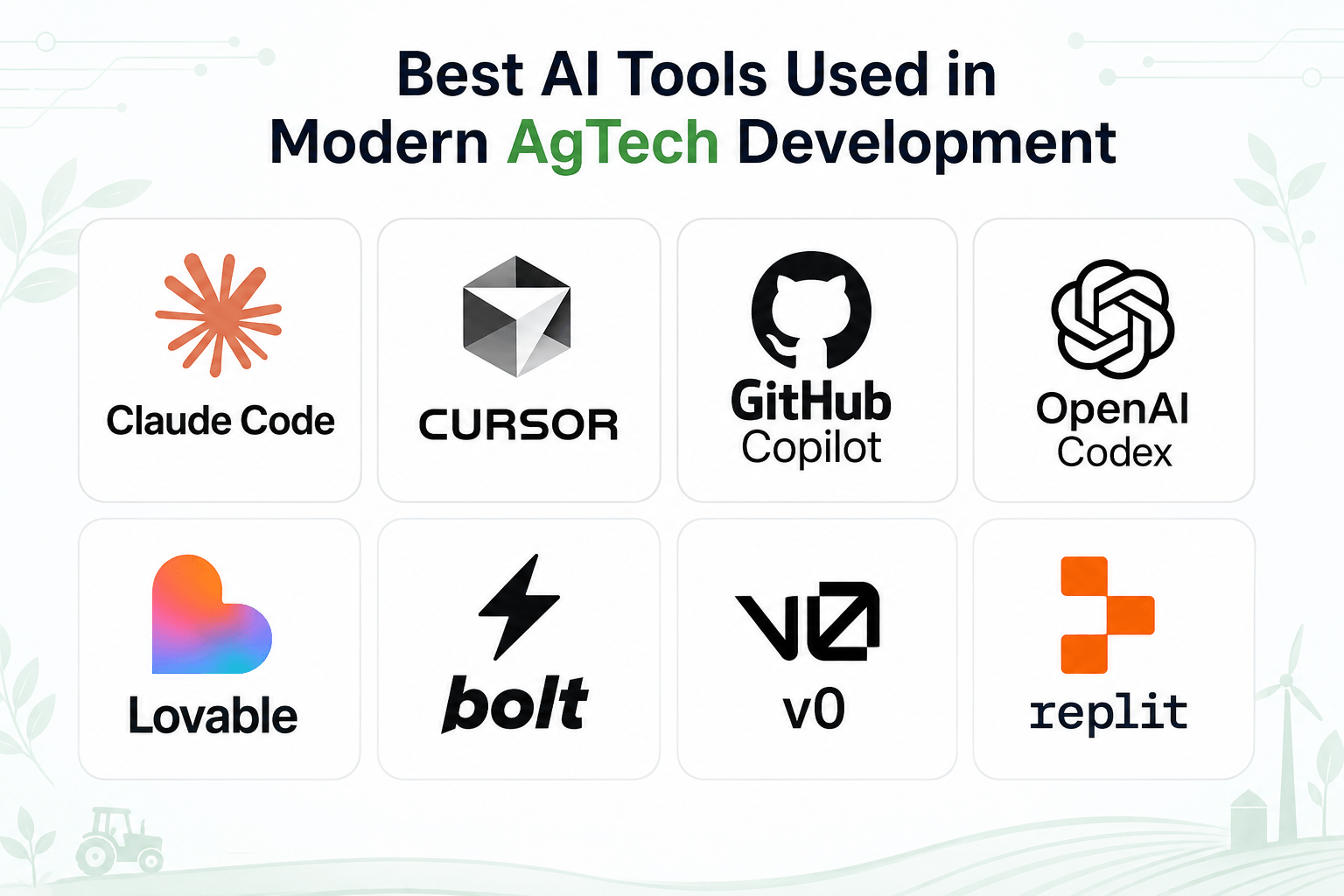
Best AI tools used in modern AgTech development
Professional engineering teams rarely rely on just one AI tool. Instead, they combine multiple assistants depending on the task.
1. Claude Code
Excellent for architecture discussions, reasoning through business logic, debugging, documentation, and generating reliable production code.
2. Cursor
An AI-powered development environment that enables engineers to build, edit, and refactor applications efficiently.
3. GitHub Copilot
Useful for accelerating repetitive coding tasks and suggesting implementations directly inside the code editor.
4. OpenAI Codex
Designed to help developers generate code, automate workflows, and solve programming challenges.
5. Lovable
Ideal for quickly building prototypes and user interfaces that stakeholders can review early.
6. Bolt
A browser-based AI development environment for rapidly creating web applications.
7. v0
Specialized in generating modern user interfaces that developers can integrate into larger applications.
8. Replit
A cloud-based development platform that combines coding, AI assistance, and rapid deployment.
These tools don’t replace software developers.
They make experienced engineers faster, more productive, and more focused on solving real business problems.
How Qaltivate uses vibe coding
At Qaltivate, AI-assisted development is integrated into our entire delivery process.
Our workflow combines agricultural expertise with modern engineering practices:
Discovery Workshop
↓
Agriculture experts define business workflows
↓
AI-assisted architecture and solution design
↓
Rapid MVP development
↓
User testing and feedback
↓
Production-ready software
↓
Continuous improvements
Our multidisciplinary teams combine:
- Agriculture domain expertise
- AI engineers
- Cloud architects
- GIS specialists
- Remote sensing expertise
- IoT integration
- API development
- AI agent development
- Quality assurance
- DevOps
The result is software that isn’t just generated faster—it is built to solve real agricultural challenges.
“The biggest misconception about Vibe Coding is that AI replaces software developers. In reality, AI replaces repetitive work, allowing experienced engineers to spend more time solving real agricultural problems. Agriculture is one of the most complex industries in the world. You still need people who understand farm operations, agronomy, data quality, machinery integration, and the business behind every workflow. AI simply helps us deliver those solutions much faster.”
Yurii Kovalchuk, CEO at Qaltivate
Yurii Kovalchuk’s, CEO of Qaltivate, top 5 tips for using Claude in AgTech projects
1. Start with business problems—not prompts
Instead of asking Claude to “build a farm app,” explain who the users are, what problems they face, the workflows they follow, and the outcomes you want to achieve. Better context leads to better results.
2. Use real agricultural data whenever possible
Provide realistic field maps, weather data, crop plans, machinery specifications, GIS layers, API examples, and operational scenarios. AI performs far better when it works with real-world agricultural context.
3. Break projects into smaller workflows
Avoid asking AI to build an entire Farm Management System in one step.
Instead, develop one workflow at a time:
- Field creation
- Crop planning
- Scouting
- Irrigation
- Harvest
This approach improves quality and makes validation easier.
4. Validate every feature with farmers and agronomists
Even if AI generates technically correct software, only real users can confirm that the workflows fit daily agricultural operations.
Early feedback prevents expensive redesigns later.
5. Never skip engineering review
Claude can write excellent code.
Experienced software engineers ensure that code is secure, scalable, maintainable, and production-ready.
Learn more about Yurii Kovalchuk, CEO of Qaltivate, and Qaltivate’s expertise in the Digital Ag Global Podcast. Enjoy the episode with Cory Willness, CEO of Croptimistic Technology Inc.
Common mistakes companies make with vibe coding
Organizations often misunderstand what AI-assisted development can achieve.
Common mistakes include:
- Using AI without clearly defining business goals
- Expecting production-ready software from AI alone
- Skipping testing and quality assurance
- Ignoring cybersecurity
- Building too much before validating the idea
- Excluding agriculture experts from the development process
- Treating AI as a replacement instead of a productivity multiplier
The most successful projects combine AI acceleration with experienced engineering, structured testing, and continuous user feedback.