Hire custom iOS Developers for AgTech
To hire custom iOS developer for AgTech industry is a strategic priority for agricultural technology companies, agribusinesses, and startups looking to deliver better digital experiences to farmers, agronomists, livestock operators, and field teams. As agriculture becomes increasingly data-driven, mobile applications are no longer optional tools—they have become critical platforms for collecting field data, managing operations, monitoring crops and livestock, and enabling real-time decision-making across distributed agricultural environments.
The growth of digital agriculture is accelerating worldwide. According to Mordor Intelligence, the global digital agriculture market is expected to grow from $26.82 billion in 2026 to $43.71 billion by 2031, driven by increasing investments in connected technologies, sensor networks, analytics platforms, and mobile-first agricultural solutions. At the same time, the global precision farming market is projected to reach $24.09 billion by 2030, fueled by the adoption of IoT, advanced analytics, and precision agriculture technologies.
Mobile applications sit at the center of this transformation. Farmers, agronomists, and agricultural businesses increasingly rely on smartphones and tablets to access crop health information, monitor field activities, manage livestock records, track machinery performance, receive weather alerts, and synchronize operational data across multiple systems. Research also shows that mobile technology is transforming agriculture by improving access to weather forecasting, crop management tools, market information, supply chain visibility, and precision agriculture services.
For AgTech companies, native iOS applications offer unique advantages. iPhones and iPads are widely used by farm managers, agricultural consultants, agronomists, equipment dealers, and enterprise agricultural organizations that require secure, high-performance mobile solutions. A custom iOS application can provide offline field functionality, geospatial mapping, satellite imagery visualization, GPS-enabled workflows, and seamless integration with farm management software, IoT devices, and cloud platforms.
In this guide, we’ll explore why businesses choose to hire custom iOS developers for the AgTech industry, the skills to look for, common agricultural mobile applications, development challenges, and how to select the right technology partner for your next AgTech project.
Hire AgTech developers
Why mobile applications are essential in modern agriculture
Agriculture is becoming increasingly data-driven, but data only creates value when it can be accessed and acted upon in the field. Mobile applications have emerged as one of the most important technologies in modern farming, connecting farmers, agronomists, livestock managers, and agricultural enterprises with the information they need to make faster and more informed decisions.
Precision agriculture
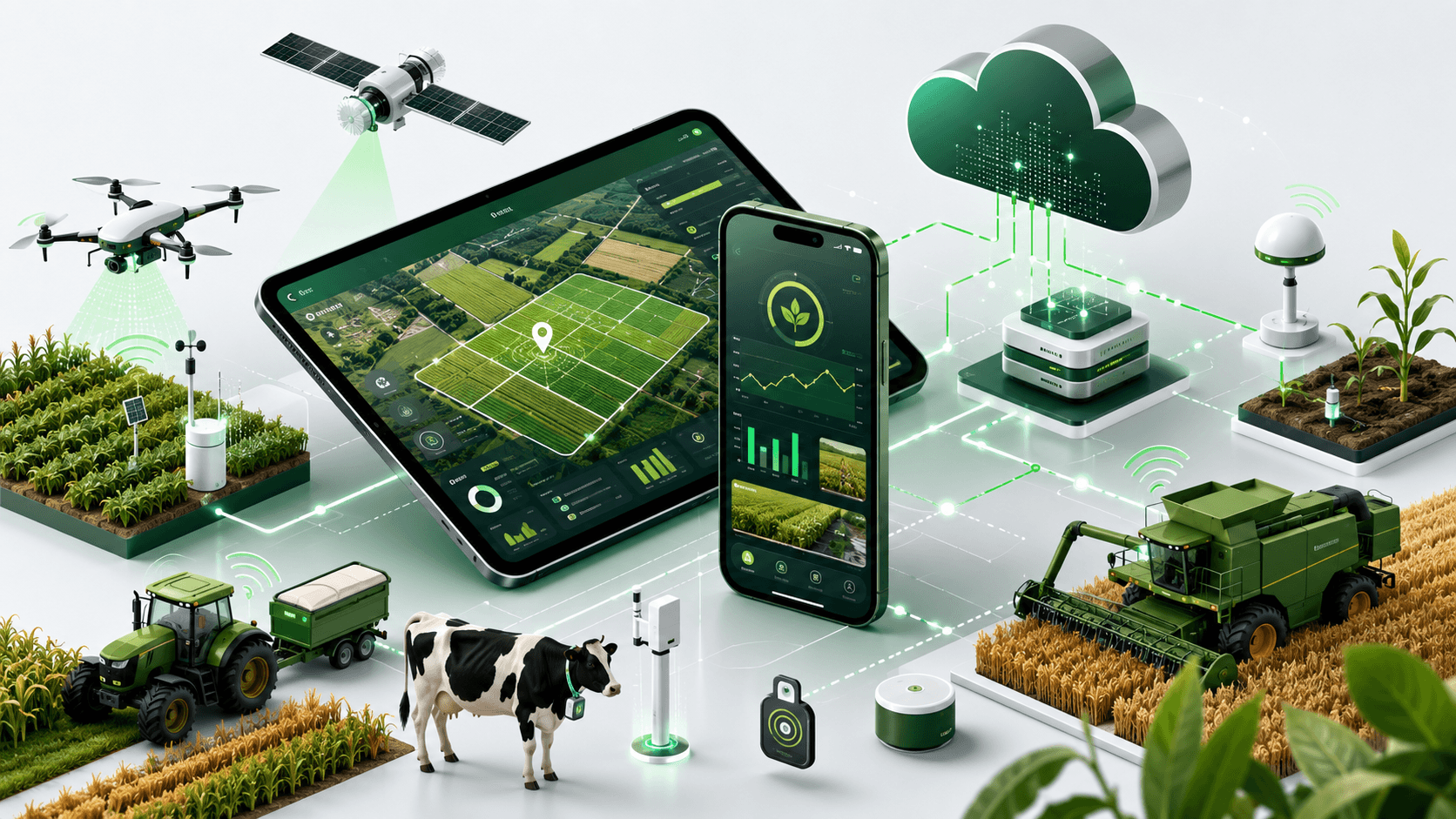
Precision agriculture relies on continuous access to field data, satellite imagery, sensor readings, weather information, and equipment performance metrics. Mobile applications allow users to view crop health maps, analyze field conditions, receive alerts, and monitor agricultural operations directly from their smartphones or tablets. This accessibility helps agricultural businesses optimize inputs, improve productivity, and respond quickly to changing field conditions.
Farm management
Modern farm management involves coordinating people, machinery, inventory, tasks, and field activities across multiple locations. Mobile applications provide a centralized interface for managing daily operations, tracking work orders, recording field activities, and monitoring farm performance. By digitizing workflows, agricultural organizations can reduce manual paperwork and improve operational visibility across the entire business.
Livestock operations
Livestock producers increasingly rely on mobile applications to manage animal records, breeding programs, health treatments, feeding schedules, and regulatory compliance. Field personnel can update information directly from barns, pastures, or feedlots, ensuring that animal data remains accurate and accessible in real time. Mobile access improves traceability while reducing administrative effort.
Agronomy workflows
Agronomists spend much of their time outside the office collecting observations, evaluating crop performance, and providing recommendations. Mobile applications streamline crop scouting, field inspections, soil sampling, and agronomic reporting. The ability to capture photos, geotag observations, and synchronize information instantly helps agronomy teams make more accurate recommendations and maintain comprehensive field histories.
Remote field monitoring
Large farming operations often manage thousands of acres spread across multiple locations. Mobile applications make remote field monitoring possible by providing access to satellite imagery, weather forecasts, IoT sensor data, irrigation systems, and machinery telemetry from anywhere. This visibility enables agricultural organizations to identify issues earlier and respond before small problems become costly operational challenges.
Real-time decision-making
Agricultural decisions are highly time-sensitive. Whether responding to changing weather conditions, pest outbreaks, equipment failures, or livestock health issues, delays can have significant financial consequences. Mobile applications deliver real-time information and alerts directly to decision-makers, helping organizations react faster and operate more efficiently.
As digital agriculture continues to evolve, many businesses choose to hire custom iOS developer for AgTech industry initiatives to build secure, scalable, and user-friendly mobile solutions tailored to the unique requirements of modern farming operations. Custom iOS applications can support offline field workflows, geospatial mapping, farm management processes, and integrations with agricultural software ecosystems, creating a competitive advantage for both AgTech providers and agricultural enterprises.
What does a custom iOS developer do in the AgTech industry?
A custom iOS developer in the AgTech industry builds mobile applications that help agricultural businesses collect, manage, and analyze data directly from the field. Unlike general-purpose mobile applications, AgTech solutions must operate in challenging environments, support complex agricultural workflows, and integrate with a wide range of technologies, from GPS systems and satellite imagery to IoT devices and farm management platforms.
Native iOS development
Native iOS development focuses on creating applications specifically for Apple’s ecosystem using technologies such as Swift, SwiftUI, and UIKit. Native applications deliver superior performance, enhanced security, and a better user experience compared to many cross-platform alternatives. For AgTech companies, this means faster data processing, smoother map rendering, improved battery efficiency, and reliable operation in demanding field conditions.
Agricultural mobile applications
Custom iOS developers create mobile solutions tailored to agricultural use cases. These applications may support crop scouting, livestock management, field inspections, machinery tracking, irrigation monitoring, inventory management, or farm operations planning. Every feature is designed around the needs of farmers, agronomists, ranch managers, and agricultural enterprises rather than generic business users.
Offline-first functionality
Many agricultural operations take place in areas with limited or unreliable internet connectivity. A critical responsibility of an AgTech iOS developer is building offline-first applications that continue to function without network access. Users must be able to record observations, capture photos, complete inspections, and access critical information while in the field. Once connectivity is restored, the application can automatically synchronize data with cloud systems.
GPS and mapping capabilities
Location data plays a central role in modern agriculture. Custom iOS developers integrate GPS functionality, geofencing, field boundary mapping, and geospatial visualization tools into agricultural applications. These capabilities enable users to navigate fields, track assets, document observations, monitor field activities, and visualize agricultural data on interactive maps.
Sensor and device integrations
Many agricultural organizations rely on connected devices to collect operational data. Custom iOS applications often integrate with soil sensors, weather stations, livestock monitoring devices, irrigation systems, RFID readers, machinery telematics platforms, and other IoT technologies. These integrations provide users with real-time insights and reduce the need for manual data entry.
Farm management workflows
Agricultural businesses depend on structured workflows to manage daily operations. A custom iOS developer designs applications that support task management, field activities, equipment inspections, livestock records, treatment logs, compliance reporting, and resource planning. By digitizing these workflows, organizations can improve efficiency, accountability, and operational visibility.
Data synchronization and cloud connectivity
Modern agricultural software rarely operates in isolation. Mobile applications must exchange information with farm management systems, ERP platforms, CRM solutions, analytics tools, and cloud databases. Custom iOS developers build secure synchronization mechanisms that ensure data remains accurate and consistent across all systems. This allows decision-makers to access up-to-date information regardless of where the data was originally collected.
For organizations planning to hire custom iOS developer for AgTech industry projects, it is important to look beyond traditional mobile development skills. The most effective developers understand both modern iOS technologies and the operational realities of agriculture, enabling them to create applications that deliver measurable value in real-world farming environments.
Key skills to look for when you hire a custom iOS developer for the AgTech industry
Not all mobile developers are equipped to build successful agricultural applications. Agriculture presents unique technical and operational challenges that require expertise beyond standard mobile app development. When evaluating candidates or development partners, organizations should look for a combination of iOS engineering skills, geospatial technology experience, agricultural workflow knowledge, and integration capabilities.
Native iOS development
The foundation of any high-quality agricultural mobile application is strong native iOS expertise. Developers should be proficient in modern Apple technologies and follow best practices for performance, security, and scalability.
Key technologies include:
- Swift for building secure and maintainable applications.
- SwiftUI for creating modern, responsive user interfaces across iPhone and iPad devices.
- UIKit for supporting advanced functionality and maintaining compatibility with existing iOS ecosystems.
Strong native development skills help ensure that agricultural applications remain reliable, responsive, and user-friendly, even when handling large datasets, maps, images, and field records.
Geolocation and GIS technologies
Location data is at the core of many agricultural workflows. Whether users are scouting crops, tracking livestock, monitoring equipment, or managing field operations, accurate geospatial functionality is essential.
Developers should have experience with:
- GPS tracking and real-time location services.
- Field boundary visualization and management.
- Geofencing and location-based alerts.
- Mapping tools such as Apple Maps, Mapbox, Google Maps, or GIS platforms.
- Geospatial data processing and visualization.
These capabilities allow agricultural organizations to create applications that provide actionable insights directly within the geographic context of their operations.
Offline data collection
Agricultural work often takes place in remote locations where internet access is limited or unavailable. As a result, offline functionality is one of the most important requirements for AgTech mobile applications.
Developers should understand how to:
- Store data locally on the device.
- Enable offline access to critical information.
- Manage synchronization when connectivity becomes available.
- Prevent data loss and synchronization conflicts.
- Optimize application performance in low-connectivity environments.
A well-designed offline-first architecture ensures that field teams can continue working productively regardless of network conditions.
Agricultural system integrations
Modern agricultural software ecosystems consist of multiple interconnected platforms. Mobile applications must exchange information seamlessly across various systems to provide a unified user experience.
Developers should have experience integrating with:
- Farm management software platforms.
- ERP systems used by agribusinesses and agricultural enterprises.
- Weather APIs that provide real-time and historical weather data.
- Satellite imagery platforms that support crop monitoring and precision agriculture initiatives.
- Cloud platforms, analytics tools, and agricultural databases.
Effective integrations eliminate data silos and enable agricultural organizations to make better decisions based on a complete operational picture.
When businesses hire custom iOS developer for AgTech industry projects, they should prioritize candidates who combine strong mobile engineering expertise with an understanding of agricultural operations, geospatial technologies, and connected software ecosystems. This combination is often the difference between a generic mobile application and a solution that delivers measurable value in real-world farming environments.
How much does it cost to hire custom iOS developers for AgTech?
One of the most common questions from CTOs and agribusiness leaders is how much it costs to hire a custom iOS developer for AgTech industry projects.
The answer depends on several factors, including developer location, project complexity, integration requirements, offline functionality, geospatial capabilities, and the number of connected systems.
According to industry pricing data from Clutch, most mobile app development companies charge between $25 and $49 per hour, although rates vary significantly by region and expertise level. Specialized iOS developers with experience in agriculture, geospatial technologies, IoT integrations, and precision agriculture workflows often command higher rates.
For AgTech companies, hiring developers with agricultural domain knowledge can reduce project risks and shorten development timelines because they already understand farm operations, field workflows, livestock management processes, and agricultural data requirements.
Average iOS developer hourly rates by region
The cost of hiring iOS developers varies significantly across global markets. Rates are influenced by factors such as developer experience, local labor costs, industry specialization, and technical expertise. For AgTech projects, developers with experience in agriculture, GIS mapping, IoT integrations, offline mobile applications, and farm management systems typically charge higher rates than general mobile developers. The table below provides average hourly rates commonly found across software development marketplaces, agency directories, and outsourcing platforms.
| Region | Typical Hourly Rate |
|---|---|
| South Asia | $15 – 40 |
| Eastern Europe | $30 – 60 |
| Latin America | $35 – 70 |
| Western Europe | $80 – 120 |
| United Kingdom | $100 – 200 |
| United States & Canada | $120–150+ |
Important: Hourly rates alone do not determine project costs. An experienced AgTech development team may charge a higher rate but deliver faster, reduce technical debt, and avoid costly mistakes related to agricultural workflows, geospatial data processing, offline functionality, and integrations with farm management or precision agriculture systems. For many agribusinesses, overall project efficiency matters more than selecting the lowest hourly rate.