
Irrigation scheduling software: how to build smarter irrigation system
Irrigation scheduling software addresses a critical challenge in modern agriculture: applying the right amount of water at the right time to crops and landscapes in order to maximize yields, minimize waste, and improve water use efficiency. The importance of irrigation scheduling has grown as water scarcity, rising costs, and climate variability put pressure on farm operations around the world. Efficient irrigation scheduling has been shown to significantly improve water use efficiency and increase productivity by aligning irrigation decisions with crop water requirements and real-time environmental data — reducing unnecessary water application and boosting sustainability.
Modern irrigation scheduling software supports a variety of data-driven scheduling techniques that significantly improve water efficiency, crop performance, and operational scalability. The growing reliance on software-based irrigation reflects its strategic importance: the global irrigation scheduling software market was valued at $1.2 billion in 2024 and is forecasted to reach $3.1 billion by 2033, growing at a CAGR of 11.2%. This growth is driven by increasing water scarcity, rising input costs, and the shift from static, manual irrigation scheduling methods to automated, sensor- and AI-enabled systems.
What is irrigation scheduling software?
Irrigation scheduling software is a digital system that determines when, how much, and where water should be applied to crops or landscapes to meet crop water requirements efficiently.
In practice, irrigation scheduling software replaces static calendars, spreadsheets, and manual decisions with data-driven logic based on soil moisture, crop type, growth stage, weather forecasts, and system constraints.
From a technical perspective, irrigation scheduling software can exist as:
– A standalone irrigation scheduling app
– A feature inside irrigation management software
– A component of automated irrigation scheduling software connected to controllers, sensors, and IoT devices
Irrigation scheduling software as a core module of irrigation management software
Irrigation scheduling software rarely works in isolation. In real-world deployments, it is most effective when embedded as a core module within a broader irrigation management software platform that connects planning, execution, monitoring, and service operations. This integrated approach is what enables scalable, automated, and commercially viable irrigation systems.
Modern irrigation management software typically combines multiple operational and decision-support layers, including:
Irrigation monitoring and scheduling
Continuous tracking of irrigation events, water usage, and system performance, combined with dynamic irrigation scheduling methods that adapt to changing conditions.
Field and zone management
Management of fields, blocks, zones, and valves, allowing irrigation scheduling to be applied at the correct spatial resolution rather than as a one-size-fits-all approach.
Sensor and weather data ingestion
Integration of soil moisture sensors, weather stations, and forecast APIs to support data-driven irrigation scheduling criteria and methods instead of static rules or spreadsheets.
Irrigation scheduling tools and charts
Visual irrigation scheduling charts, diagrams, and dashboards that replace manual irrigation scheduling Excel files or irrigation scheduling PDFs and PPTs traditionally used for planning.
Alerts, reports, and dashboards
Real-time alerts for under- or over-irrigation, automated reporting on irrigation water scheduling, and performance dashboards for agronomists, operators, and managers.
CRM that integrates with irrigation scheduling
Customer and field data linked directly to irrigation activity, especially important for irrigation service companies managing multiple clients and sites.
Scheduling of irrigation technicians
Built-in irrigation service scheduling software and software for scheduling irrigation technicians, enabling efficient dispatch, maintenance planning, and service execution.
Asset and service management
Tracking pumps, controllers, valves, and wi-fi irrigation scheduling devices alongside service history and maintenance workflows.
In this architecture, irrigation scheduling software acts as the decision engine—calculating recommendations based on crop water requirement and irrigation scheduling logic—while irrigation management software provides the operational layer that executes, monitors, services, and scales those decisions across farms, landscapes, or commercial irrigation operations.
Importance of irrigation scheduling software for various agriculture companies
The importance of irrigation scheduling varies by role, but across the entire ecosystem it directly impacts profitability, resource efficiency, and operational scalability. Well-designed irrigation scheduling software delivers different types of value to each stakeholder involved in irrigation planning, execution, and service delivery.
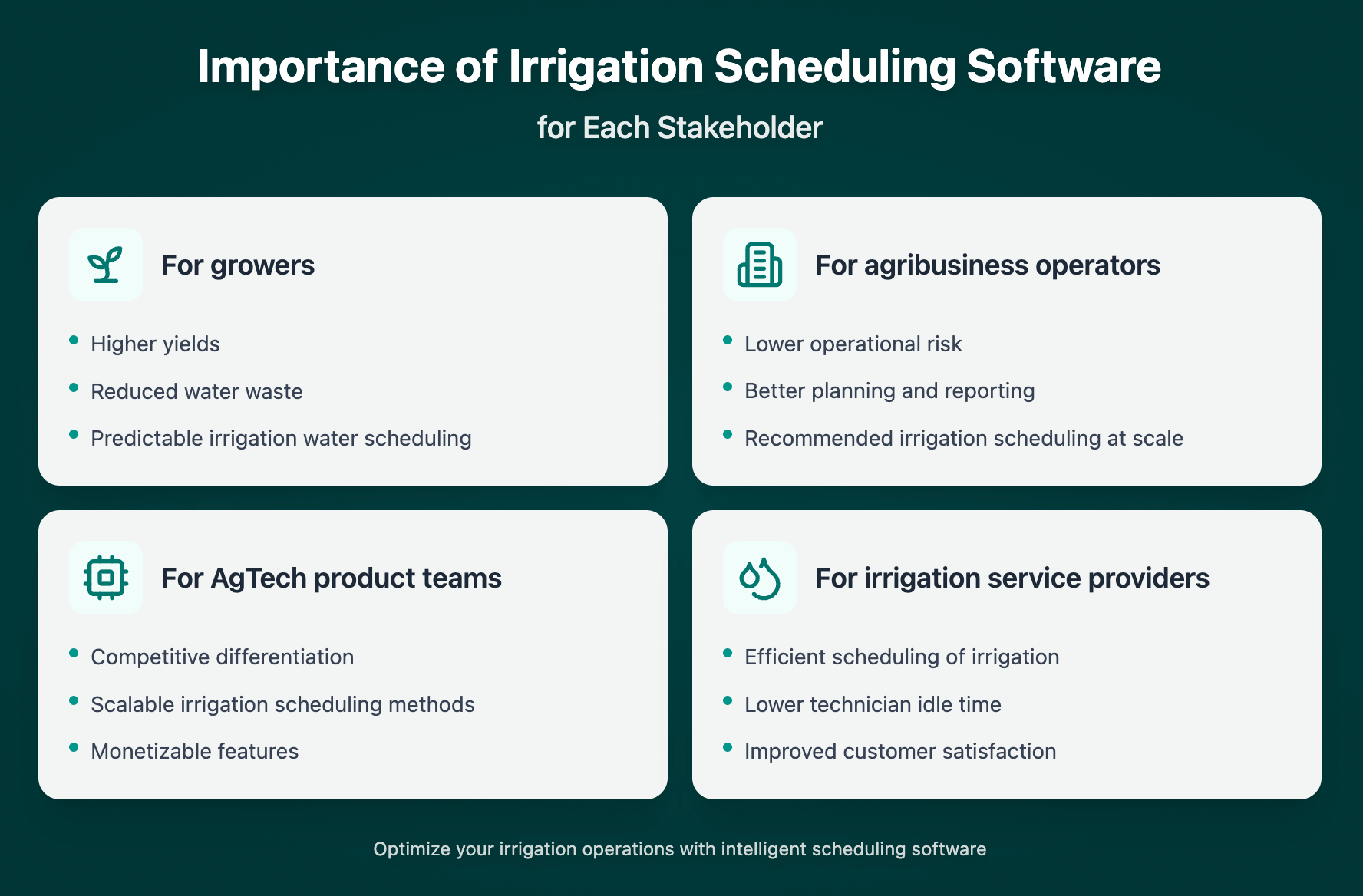
Software for irrigation scheduling for growers and farm managers
For growers, irrigation decisions are tightly linked to yield, quality, and cost control. Irrigation scheduling software replaces guesswork, static irrigation scheduling charts, and manual irrigation scheduling Excel files with data-driven recommendations tailored to specific crops, soils, and growth stages.
Key benefits include:
– Higher yields through precise crop water requirement and irrigation scheduling aligned with plant development
– Reduced water waste by accounting for factors affecting irrigation scheduling such as soil moisture, weather, and evapotranspiration
– Predictable irrigation water scheduling, helping growers plan labor, energy use, and input costs
Crop-specific use cases such as corn irrigation scheduling, cotton irrigation scheduling, soybean irrigation scheduling, vineyard irrigation scheduling, almond irrigation scheduling, potato irrigation scheduling, tomato irrigation scheduling, maize irrigation scheduling, sugarcane irrigation scheduling, and watermelon irrigation scheduling benefit significantly from software-based scheduling compared to manual methods.
Advanced platforms also support ai-based irrigation scheduling, enabling adaptive recommendations that improve over time as more field data is collected.
Irrigation scheduling for agribusiness operators
For agribusinesses managing multiple farms, regions, or crop types, the challenge is scale. Irrigation management software with embedded automated irrigation scheduling software allows organizations to standardize best practices while still adapting to local conditions.
Value for agribusiness operators includes:
– Lower operational risk by reducing over- or under-irrigation across large operations
– Better planning and reporting using centralized irrigation scheduling tools, dashboards, and irrigation scheduling diagrams
– Recommended irrigation scheduling at scale, based on consistent irrigation scheduling criteria and methods rather than individual operator judgment
Instead of relying on irrigation scheduling methods PDF documents or manual reporting, agribusinesses gain real-time visibility into irrigation performance across all assets.
Irrigation scheduling for AgTech product teams
For AgTech companies, irrigation scheduling software is not just a feature—it is a competitive differentiator. Product teams must support diverse irrigation scheduling methods, crop models, and regional practices while maintaining performance and scalability.
Key advantages include:
– Competitive differentiation through custom irrigation scheduling and AI-enhanced recommendations
– Scalable irrigation scheduling methods that support multiple crops, regions, and irrigation systems
– Monetizable features, such as premium irrigation scheduling apps, analytics, or integrations with smart controllers
Modern platforms move beyond basic scheduling to include irrigation scheduling and smart controllers, customizable irrigation scheduling controllers, and integration with wi-fi irrigation scheduling devices. This creates opportunities for recurring revenue and long-term customer engagement.
Irrigation software for irrigation service providers
For irrigation contractors and service companies, operational efficiency is as important as agronomic accuracy. Irrigation service scheduling software combined with irrigation scheduling capabilities enables better coordination between field recommendations and service execution.
Benefits include:
– Efficient scheduling of irrigation tasks across multiple clients and locations
– Lower technician idle time through optimized routing and workload planning
– Improved customer satisfaction by delivering consistent, timely service supported by accurate irrigation scheduling data
Tools such as software for scheduling irrigation technicians, software for lawn irrigation scheduling, and CRM systems that integrate with irrigation scheduling allow service providers to manage both residential and commercial operations more effectively.
How irrigation scheduling software works
At its core, irrigation scheduling software translates agronomic data into precise, actionable irrigation decisions. While implementations vary by crop, region, and system complexity, most modern solutions follow the same technical structure: data inputs → decision logic → outputs → execution. Understanding how this process works is essential when designing, upgrading, or evaluating irrigation scheduling solutions.
Data inputs for irrigation scheduling software
Effective irrigation scheduling depends on the quality and variety of data being processed. Modern irrigation management software aggregates multiple input sources to move beyond static scheduling methods.
Typical data inputs include:
Soil moisture sensors
Real-time or near-real-time measurements used to determine actual water availability in the root zone.
Weather forecasts
Temperature, rainfall, humidity, wind, and evapotranspiration data that directly influence irrigation water scheduling.
Crop type and growth stage
Crop-specific parameters used for crop water requirement and irrigation scheduling, supporting scenarios such as corn irrigation scheduling, cotton irrigation scheduling, vineyard irrigation scheduling, or almond irrigation scheduling.
Field characteristics
Soil type, slope, irrigation system capacity, and zone configuration, all of which affect irrigation scheduling criteria and methods.
Historical irrigation data
Past irrigation events, yield outcomes, and system performance data used to refine irrigation scheduling methods over time.
Core logic inside irrigation scheduling software
The decision-making layer is where irrigation software delivers its real value. This logic can range from simple rule-based approaches to advanced AI-driven systems.
Key components of the core logic include:
Irrigation scheduling definition rules
Baseline logic defining when irrigation should start, stop, or be adjusted based on thresholds and conditions.
Irrigation scheduling formula calculations
Mathematical models that estimate water demand using evapotranspiration, soil moisture depletion, and crop coefficients.
AI-based irrigation scheduling models
Machine learning models that continuously improve recommended irrigation scheduling by learning from historical and real-time data.
Factors affecting irrigation scheduling
Dynamic inputs such as weather variability, system constraints, crop stress indicators, and regulatory limits that influence final decisions.
Unlike traditional irrigation scheduling Excel files or irrigation scheduling methods PDFs, software-based logic enables continuous recalculation and adaptation.
Outputs generated by scheduling software
Once decisions are made, irrigation scheduling software converts them into outputs that operators, agronomists, and systems can act on.
Common outputs include:
Irrigation scheduling chart
System-level views showing how scheduling decisions map to irrigation infrastructure and zones.
Alerts and recommendations
Notifications for under-irrigation, over-irrigation, or deviations from recommended irrigation scheduling.
Automated execution via controllers
Commands prepared for execution through irrigation controllers and smart devices. These outputs replace static irrigation scheduling PDFs, PPTs, and charts with interactive, real-time tools.
Execution and automation layer
The final step is execution, where automated scheduling software for irrigation turns recommendations into action.
Execution typically includes:
Automated software triggers actions
Irrigation events are automatically initiated based on scheduling logic without manual intervention.
Integration with Wi-Fi irrigation scheduling devices
Direct communication with smart controllers, valves, and customizable irrigation scheduling controllers deployed in the field.
Manual override options for operators
Human controls allowing agronomists or technicians to adjust or override scheduling when needed.
This combination of automation and control ensures that irrigation scheduling remains both precise and practical, supporting real-world operational requirements while enabling scalable, data-driven irrigation management.
Irrigation scheduling methods supported by software
Here’s how software-based irrigation scheduling elevates farm water management:
Software-enabled irrigation scheduling methods
Soil-based scheduling
Leveraging data from soil moisture sensors and IoT devices, soil-based scheduling adjusts irrigation based on real-time soil water content, leading to better water use efficiency compared to weather-only approaches. For example, research shows soil-based irrigation scheduling systems can reduce water use by nearly 29% and improve crop water productivity by over 50% compared to some conventional methods.
Weather-based scheduling
By using weather forecasting and evapotranspiration models, weather-based scheduling anticipates water loss due to heat, wind, and humidity, enabling irrigation timing that aligns with changing environmental conditions.
Crop evapotranspiration models
These models calculate crop water demand based on plant type, growth stage, and local conditions — replacing manual irrigation scheduling charts and irrigation scheduling Excel files with dynamic, scientific calculations that reduce guesswork.
AI-driven predictive scheduling
As AI technologies become more prevalent in agriculture — with the global AI in agriculture market valued at several billion USD and growing rapidly — predictive models in irrigation software can forecast optimal irrigation timing and quantity based on historical and real-time data patterns.
Hybrid scheduling methods
Combining soil, weather, and crop models, hybrid approaches balance multiple data sources to enhance precision, allowing farmers to adapt irrigation not just to current conditions but anticipated changes.
Limitations of legacy irrigation scheduling approaches
Despite the availability of modern digital tools, many operations still rely on legacy scheduling methods, such as:
– Irrigation scheduling Excel files — Spreadsheets that require manual updates and lack real-time responsiveness.
– Irrigation scheduling PDF or PPT documents — Static charts or slides that fail to reflect real field conditions.
– Static irrigation scheduling methods PDF — Formal documents with rules and instructions that don’t adapt to dynamic weather or soil changes.
While these legacy methods (such as simple guides or printed irrigation scheduling methods PDF files) can serve as references, they limit scalability and accuracy compared with automated, data-driven approaches. Software-enabled scheduling not only updates irrigation recommendations in real time but also supports integration with smart controllers and connected devices, enabling automated scheduling software to trigger irrigation events and reduce manual oversight.
As adoption of precision agriculture increases and pressure on water resources grows, transitioning from static legacy approaches to automated scheduling software becomes essential for efficient, sustainable, and high-performing irrigation management.
Cost of irrigation scheduling software development
The cost of building or upgrading a scheduling solution depends heavily on its technical depth, target users, and long-term scalability requirements. While exact pricing varies by scope and region, most projects fall into several predictable ranges.
Approximate cost ranges (high-level):
– MVP scheduling app: low to mid five figures, typically focused on a limited number of crops, basic scheduling methods, and minimal integrations
– Production-grade platform: mid five to six figures, designed for commercial use with robust logic, analytics, and operational workflows
– Enterprise-scale automated solution: six figures and above, supporting multiple regions, crops, users, and integrations with enterprise systems
These ranges reflect not just development effort, but also architectural decisions that influence reliability, performance, and future extensibility.
Key cost drivers to consider
Several factors have a direct impact on overall investment:
Custom scheduling logic
Projects that require crop-specific models, regionally adapted rules, or advanced optimization demand more design, validation, and testing.
AI and machine learning requirements
Predictive models, adaptive recommendations, and continuous learning pipelines increase complexity but also long-term value.
System integrations
Connecting scheduling logic with CRM platforms, ERP systems, IoT sensors, controllers, or third-party data sources significantly affects scope and effort.
Number of supported crops
Each additional crop introduces new parameters, coefficients, and validation requirements, especially for perennial or specialty crops.
Maintenance and support scope
Ongoing updates, model tuning, infrastructure monitoring, and user support are essential for reliable operation and should be planned from the start.
Ultimately, the cost reflects how strategically the system is positioned — whether as a simple planning tool or as a scalable, data-driven decision engine embedded within broader irrigation and farm operations.