
Agriculture supply chain software: the complete guide for business owners
What is agriculture supply chain software?
Agriculture supply chain software is a digital system designed to manage, automate, and optimize operations across the agriculture value chain. This includes activities such as procurement, production planning, inventory management, logistics, forecasting, and quality control.
By consolidating data across farms, suppliers, processors, and distributors, agriculture supply chain management software enables a unified, accurate view of operations. It reduces waste, improves communication, and helps businesses stay compliant with regulatory requirements.
Modern tools often come as an agriculture supply chain platform, offering IoT integrations, real-time monitoring, and end-to-end product traceability. Whether implemented as standalone tools or a single agriculture supply chain solution, these platforms support:
1. Better demand and supply planning
2. Automated logistics and routing
3. Quality and safety management
4. Traceability from origin to retail
5. Sustainability and carbon tracking
In a world where efficiency, food safety, and transparency matter more than ever, agriculture supply chain software is becoming the foundation of digital agriculture.
Why the agriculture supply chain is more complex than ever
The agriculture supply chain is one of the most complex supply networks in the world. Unlike manufacturing or retail, the agriculture food supply chain deals with biological processes, unpredictable weather patterns, fragmented production systems, and highly sensitive perishables. From farm inputs and production to processing, distribution, and retail, every stage of the supply chain for agriculture requires precision, coordination, and real-time decision-making.
However, traditional agriculture supply operations often rely on manual processes, disconnected systems, and limited visibility. This makes supply chain management in agriculture difficult, especially when producers and agribusinesses must meet global standards, sustainability goals, and consumer demands for transparency.
That’s why agriculture supply chain management has shifted from paper-based workflows to high-performance digital systems built to monitor, optimize, and trace agricultural products from seed to shelf. Modern agriculture supply chain software is no longer optional—it is essential for efficiency, profitability, and resilience.
Key challenges in the agriculture supply chain (and why software matters)
The supply chain agriculture sector faces challenges unlike any other. Biological variability, extreme weather, labor shortages, and fluctuating market prices create ongoing instability. Without digital tools, these challenges become nearly impossible to manage at scale.
Major issues affecting the supply chain in agriculture include:
Climate risks and environmental uncertainty
Rising temperatures, unpredictable rainfall, pests, and diseases disrupt production.
This intensifies concerns around agriculture supply chain climate risk and broader agriculture supply chain climate change vulnerabilities.
Fragmentation and poor communication
Smallholder farmers, distributors, cooperatives, exporters, and processors often operate in silos. This fragmentation leads to errors, delays, and food loss.
Logistics and storage bottlenecks
Perishable goods require fast, reliable transportation and cold-chain management—something many regions still lack.
Market volatility
Price fluctuations, demand shifts, and global trade disruptions create uncertainty for producers and buyers.
Regulatory pressure
Food safety laws require detailed reporting, traceability, and documentation.
Software solutions help mitigate these challenges, providing visibility, predictive analytics, and automated workflows that stabilize operations even in unpredictable conditions.
Traceability in agriculture and the role of technology
Modern consumers demand to know where their food comes from, how it was produced, and whether it meets safety and sustainability standards. As a result, traceability in agriculture and food supply chain operations is now a regulatory and commercial necessity.
Technology enables supply chain traceability agriculture systems that monitor every step of the journey—seed sourcing, field practices, harvest dates, processing, shipping, and retail distribution.
Digital traceability unlocks key benefits:
– Rapid recall management
– Fraud prevention
– Sustainability verification
– Market differentiation
Companies are adopting traceability tools to address real-world agriculture supply chain use-cases, including:
– Organic and regenerative certifications
– Pesticide and input tracking
– Animal welfare verification
– Food origin assurance
With rising demand for transparency, agriculture supply chain innovation will continue accelerating—shaping a agriculture supply chain future defined by total visibility.
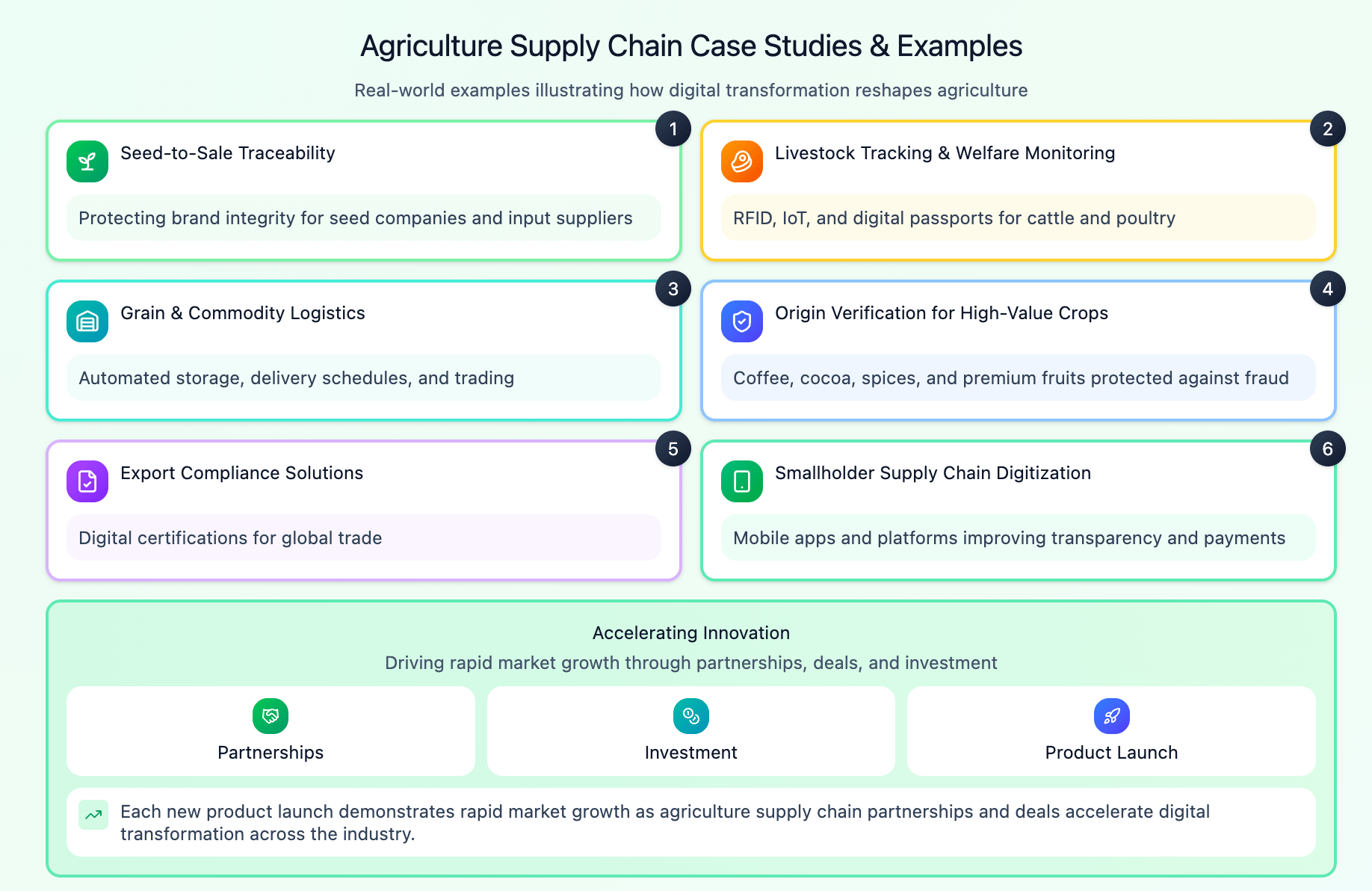
Agriculture supply chain examples
These examples show how agriculture supply chain partnerships, agriculture supply chain deals, and agriculture supply chain investment are accelerating innovation. Each new agriculture supply chain product launch demonstrates rapid market growth.
Global trends in the agriculture supply chain
The agriculture world is in the middle of a deep digital shake-up. Investors, technology vendors, and agribusinesses are all betting on smarter, more connected supply chains.
On the technology side, macro numbers tell the story:
– The global smart agriculture market is estimated at about $25.3 billion in 2024 and is projected to reach $54.7 billion by 2030, a CAGR of roughly 13–14%, driven by IoT, data platforms, and automation.
– The broader global supply chain management market (all industries) is expected to grow from $25.7 billion in 2024 to $48.6 billion by 2030 (CAGR 11.4%), reflecting rapid adoption of cloud-based planning, execution, and analytics tools.
– Within that, the agriculture supply chain management market alone is projected to rise from about $1.3 billion in 2024 to $3.2 billion by 2031, growing at 12% CAGR, underlining how quickly farm-to-fork operations are being digitized.
Analyst firms see this digital momentum as structural, not temporary. Gartner highlights eight strategic supply chain technology trends for 2024, including composite AI, advanced analytics, data governance, and hyperautomation, all aimed at more resilient and collaborative supply chains. Their supply chain predictions also note that roughly half of supply chain organizations will invest in AI and advanced analytics applications through 2024, signalling that AI-enabled planning will soon be standard rather than experimental.
Against this backdrop, several key agriculture supply chain trends are shaping strategy in the coming years:
– Digital platforms replacing manual workflows – End-to-end agriculture supply chain management platforms are consolidating farm, procurement, logistics, and quality data into a single source of truth, supporting faster and more accurate decisions across regions and partners.
– AI-driven forecasting and planning – AI models are increasingly used to predict yields, demand, and price movements, helping agribusinesses buffer against volatility and supply chain shocks. McKinsey notes that automated planning systems can significantly reduce costs and improve resilience in agricultural supply chains.
– Satellite-powered climate and crop monitoring – Remote sensing and weather intelligence are being integrated into supply chain planning to anticipate climate risks and adjust sourcing, logistics, and inventory strategies before disruptions hit.
– End-to-end farm-to-fork traceability – Digital traceability solutions (often combined with blockchain) are becoming a core requirement for food safety, export compliance, and brand differentiation, as shown by recent reviews of blockchain and traceability in food supply chains.
– Carbon footprint and Scope 3 tracking – Food and agriculture companies are under pressure to measure and reduce supply chain emissions, with frameworks like SBTi FLAG encouraging precise carbon tracking from farm to final product.
– Automation of warehouses and logistics – Robotics, sensors, and automated inventory management are being piloted and scaled to handle perishable goods more efficiently and reduce labor bottlenecks.
– Robotics and drone-based data collection – Drones, field robots, and AI-enabled vision systems are increasingly cited by Gartner as high-impact technologies for future supply chains, including agriculture, enabling real-time monitoring of crops, inventory, and infrastructure.