Asset tracking solutions in agriculture
Why is asset tracking important?
Modern farms operate with a wide mix of vehicles, tools, machinery, livestock assets, and input materials. When these items are not monitored properly, farms experience significant financial losses—often without realizing the cause. Asset tracking solutions and asset management tracking systems help agricultural businesses prevent these losses by giving full visibility into where equipment is, how it’s used, and whether it’s operating efficiently.
One of the biggest drains on farm profitability is downtime. A tractor that cannot be found quickly, a sprayer waiting for repairs, or a lost attachment during harvest can result in wasted labor hours, unnecessary fuel consumption, and delayed field operations. With modern asset tracking solutions, farmers gain real-time insights into their equipment’s location, status, and movement, which reduces time loss and prevents operational bottlenecks.
Theft is another increasing concern, especially for high-value agricultural machinery. A stolen tractor, trailer, or GPS monitor can cost thousands to replace and cause major disruption during peak seasons. A dependable asset tracking system and asset tracking tool can trigger instant alerts if equipment leaves designated zones and help authorities recover stolen assets faster.
During critical periods like planting and harvest, every minute matters. Misplaced tools, delayed trucks, or an unavailable implement can derail the entire workflow. Digital asset tracking software for business helps teams coordinate better and maintain seasonal productivity.
Finally, asset tracking strengthens safety, compliance, and insurance accuracy. Many insurance providers now support or even require digital asset management, especially for large farms. An organized tracking system ensures traceability, improves worker safety, and simplifies reporting for audits.
What is asset tracking?
What is asset tracking? It’s the process of monitoring the location, movement, and condition of physical farm assets—machinery, tools, livestock, and inventory—using digital technologies. A modern asset tracking system replaces manual spreadsheets and paper logs with automated, real-time visibility.
Unlike inventory tracking, which focuses on counting materials such as seeds or chemicals, asset tracking focuses on equipment and movable items. It monitors where assets are, who is using them, and how often they’re deployed.
An advanced asset tracking ecosystem typically includes asset tracking software, an asset tracking device, and a mix of sensors and connectivity options. Hardware asset tracking covers physical tags, GPS units, or RFID labels, while software asset tracking collects data, analyzes it, and presents it on dashboards. Combined, these tools help farms reduce losses, improve utilization, and optimize operations.
Asset tracking in agriculture
As agriculture becomes more mechanized and data-driven, modern farms rely heavily on asset tracking solutions to stay efficient and competitive. Whether in Canada, the U.S., or Europe, farms are adopting systems that simplify workflows, automate reporting, and reduce operational risks. With innovations in IoT, real-time monitoring, and geospatial technologies, asset tracking Canada and other major markets are driving widespread adoption.
Agricultural businesses benefit from asset tracking system visibility, asset tracking tools, and asset tracking safety software that improve traceability, compliance, and equipment management.
How does asset tracking work?
Modern farms rely on a wide range of asset tracking tools to monitor equipment and reduce operational inefficiencies. At the core of the system is a digital platform that gathers location and usage data from sensors and devices connected through IoT networks. This data is processed by asset GPS tracking software, which displays asset status in real time.
Connectivity is essential. Technologies like RFID, GPS, cellular, and low-power radio networks enable asset tracking IoT connectivity, ensuring that farm assets remain visible even in remote fields. With asset tracking IoT and IoT asset tracking, sensors continuously transmit data to cloud dashboards where farm managers can review movement patterns, schedule maintenance, and respond to alerts.
The workflow typically looks like this:
1. Attach a tag or tracking device to an asset.
2. Sensors collect data about location, movement, or usage.
3. Connectivity modules (GPS, cellular, Bluetooth, RFID) transmit the information.
4. The cloud dashboard displays real-time insights.
5. Automation triggers alerts—speeding, tampering, entering restricted areas, or unusual downtime.
This system eliminates manual errors and gives farms full visibility into daily operations.
What can be tracked with asset tracking systems?
Modern asset tracking solutions are designed to monitor a wide range of agricultural assets—both mobile and stationary. From heavy machinery to livestock and consumable materials, these systems give farmers real-time visibility into the tools, equipment, and resources that keep their operations running. Below are the main categories of assets that can be effectively tracked using GPS, RFID, and IoT technologies.
1. Machinery and Equipment
This includes the full spectrum of farm machinery such as tractors, combines, sprayers, seeders, irrigation pumps, tillage tools, and utility vehicles. Tracking these assets helps farmers understand where their equipment is, how often it’s used, and whether it’s operating efficiently. It also reduces downtime by preventing misplacement and helps protect high-value machinery from theft.
2. Livestock and Animal Movement
Asset tracking isn’t limited to machinery—livestock can also be monitored using RFID ear tags, GPS collars, or IoT sensors. Farmers can track the movement and location of herds or individual animals, monitor grazing patterns, prevent livestock loss, and improve animal safety. For large operations or open-range systems, this visibility significantly reduces search time and improves overall herd management.
3. Other Valuable Farm Assets
Many agricultural operations rely on equipment and materials that are smaller, movable, or easily misplaced. Asset tracking can be applied to:
1. Chemical storage tanks
2. Fertilizer and seed containers
3. Trailers and attachments
4. Portable fuel tanks
5. Irrigation components
6. High-value tools and equipment
Tracking these items ensures they are properly accounted for, reduces theft or loss, and supports better workflow planning during peak seasons.
What is real-time asset tracking?
Real time asset tracking solutions provide continuous, instant updates about where assets are and how they are being used. Unlike passive tracking—which only records data when scanned or updated manually—real-time systems send constant location signals.
In agriculture, real-time insights provide tremendous value. A farm manager can see where a combine is during harvest, track the movement of a trailer between fields, or detect if a piece of machinery is stolen or diverted from its route. A real-time asset tracking solution backed by asset GPS tracking software helps react immediately to issues, prevent losses, and optimize daily workflows.
With GPS technology, farms gain reliable visibility over large fields, remote areas, and long-distance transport. It enables better fleet management, more efficient routing, and faster response times.
What is IoT asset tracking?
An IoT based asset tracking system uses smart sensors connected through IoT networks to track equipment, environmental conditions, and usage patterns. This enables a deeper level of automation and intelligence than traditional systems.
Asset tracking IoT devices can monitor more than just location—they track temperature, vibration, humidity, motion, and machine health. With IoT asset tracking, farms can identify when equipment needs maintenance, when livestock enters or leaves a pen, or when environmental conditions threaten crop storage.
Connectivity is delivered through LPWAN, NB-IoT, LTE-M, Wi-Fi, or Bluetooth. These networks ensure stable asset tracking IoT connectivity, even in isolated fields.
IoT-powered systems also support predictive maintenance. By monitoring vibrations and engine hours, sensors can alert farmers before a breakdown occurs—reducing downtime and repair costs.
What is asset tracking software?
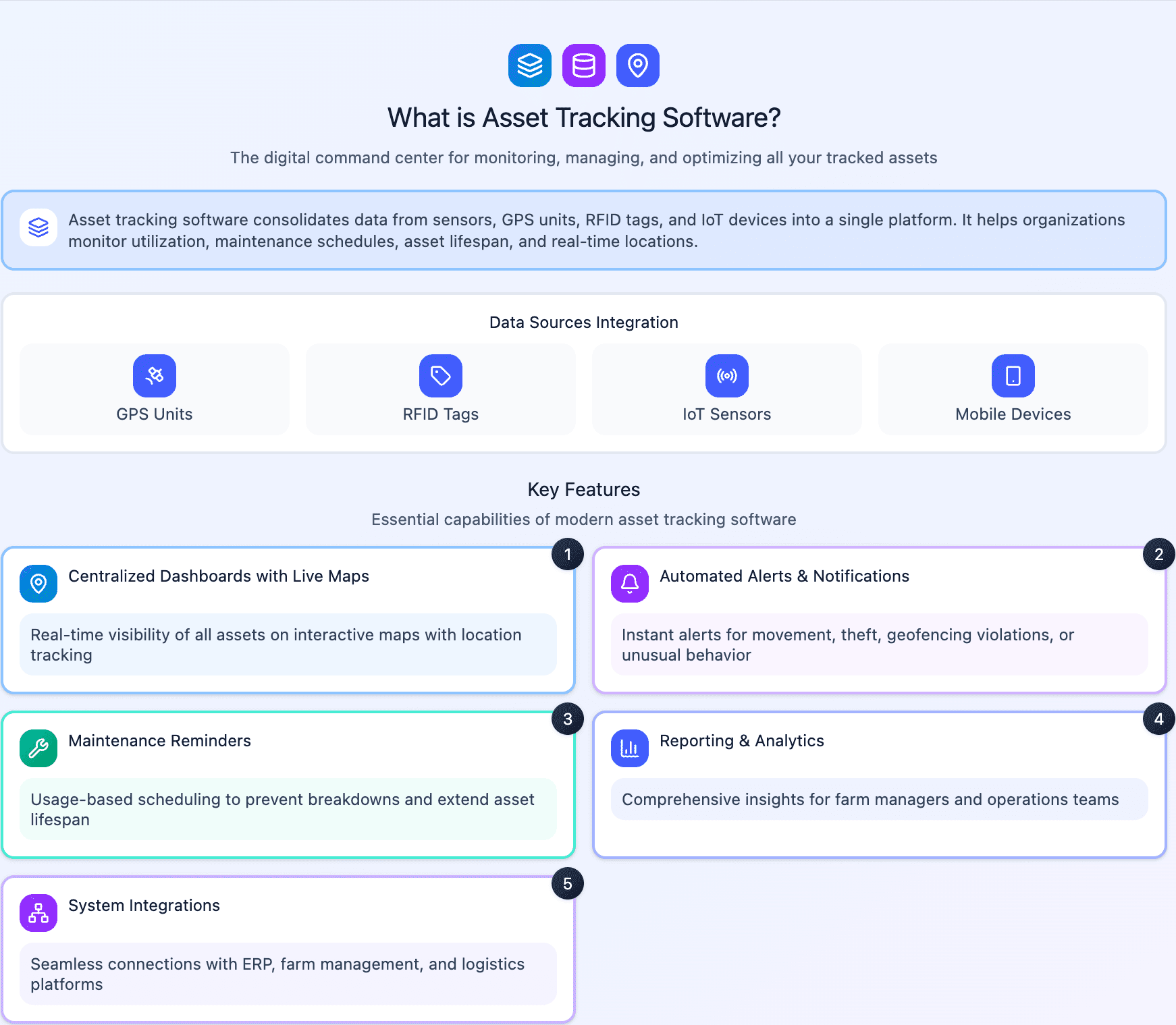
Asset tracking software is the digital command center for all tracked assets. It consolidates data from sensors, GPS units, RFID tags, and IoT devices into a single platform. Both software asset tracking and asset tracking software for business help organizations monitor utilization, maintenance schedules, asset lifespan, and real-time locations.
Key features include:
1. Centralized dashboards with live maps
2. Automated alerts for movement, theft, or unusual behavior
3. Maintenance reminders based on usage
4. Reporting and analytics for farm managers and operations teams
5. Integrations with ERP systems, farm management software, and logistics platforms
High-quality software also supports asset management tracking, giving farm owners a complete history of each asset—from purchase to disposal.
How much does asset tracking cost?
The cost of asset tracking varies depending on the technology used, the number of assets, and farm size. Most farms use a combination of GPS and RFID to balance cost and coverage.
GPS tracking costs
Hardware: $50–$300 per asset tracking device
Subscription: $10–$30/month per unit
Installation: Optional (self-install or professional)
RFID Tracking Costs
– Tags: $0.10–$5 each
– Readers: $50–$1,500
– Infrastructure: Based on farm layout
RFID asset tracking cost remains significantly lower than GPS for large asset counts.
Hardware asset tracking costs
– Includes sensors, gateways, antennas, and batteries. Prices vary depending on ruggedness and connectivity type.
Overall price ranges
– Small farms: $500–$3,000
– Mid-size farms: $3,000–$25,000
– Large operations: $25,000+ depending on complexity
A well-chosen asset tracking solution quickly pays for itself by reducing losses, downtime, and fuel waste.
In the table below, we provide more information on the potential costs of asset tracking for an agriculture project. The budget can be calculated individually and depends on the requirements of your business though:
Asset tracking cost breakdown for agriculture
| Category | Cost range | What’s Included | Key notes / Influencing factors |
|---|---|---|---|
| Software (Basic) | ~$100–$150 per year | Simple web dashboards for tracking up to several hundred assets | Ideal for small farms; limited features; no real-time data |
| Software (Advanced / Enterprise) | $0–$150+ per user/month | Real-time monitoring, mobile apps, integrations, analytics | Cost depends on user count, system complexity, and required features |
| Fleet tracking software | $14–$250+ per vehicle/month | GPS fleet management, geofencing, route optimization | Pricing varies by update frequency, accuracy, and reporting tools |
| GPS Hardware (Basic) | $10–$300 per device (one-time) | ntry-level GPS trackers with basic functionality | Lower accuracy and fewer features; good for simple location tracking |
| GPS Hardware (Advanced) | $100–$500+ per device | Rugged trackers, long battery life, high-precision GPS | Usually requires monthly data subscription ($5–$50+ per unit) |
| RFID Tags (Passive) | $0.10–$2 per tag | Low-cost tags for tools, inventory, or livestock | Requires RFID readers; best for indoor/storage environments |
| RFID Tags (Active) | $5–$50 per tag | Long-range tags with built-in battery | Higher cost due to extended range and stable signal |
| RFID Readers & Infrastructure | $50–$1,500 per reader | Handheld readers or fixed gateways | Total cost depends on number of zones and buildings to cover |
| Cloud-Based System (Total Cost of Ownership) | ~$5,000–$50,000 overall | Hardware, software licenses, cloud hosting, integrations | Cost grows with asset count, user count, and data needs |
| Monthly Subscriptions (GPS / IoT) | $5–$50+ per asset/month | Connectivity, data processing, platform use | Required for live tracking and reporting |
| Implementation / Setup Fees | $500–$5,000+ | System setup, configuration, device installation | Can include data migration or integration with farm software |
| Maintenance Costs | $50–$500+/year per device | Battery replacements, device servicing, upgrades | Depends on environment, device durability, and usage patterns |
Although asset tracking can range from very affordable to a major investment, the final price depends on several operational and technical factors. The following table outlines the main cost drivers that shape the total expense of implementing an asset tracking system in agriculture—including the number of assets you need to monitor, the technology you choose (GPS, RFID, or IoT), hardware requirements, software complexity, and the level of ongoing maintenance or support. These elements help determine both the upfront budget and the long-term cost of ownership for any farm adopting asset tracking.
| Factor | How it impacts cost |
|---|---|
| Number of assets | More assets = more tags, devices, and software seats; biggest cost multiplier. |
| Type of technology used | GPS is best for fields and wide areas (higher cost), RFID is best for barns/storage (lower cost). |
| Feature level | Real-time GPS, mobile apps, integrations, analytics increase subscription fees. |
| Hardware requirements | GPS units, RFID tags, gateways, IoT sensors all add upfront and recurring costs. |
| Implementation complexity | Integration with existing systems, custom dashboards, or large fleets increases setup fees. |
| Ongoing maintenance | Includes battery changes, device replacements, and software support subscriptions. |