
Difference between AI and Gen AI: what It means for agriculture
The difference between AI and Gen AI is becoming one of the most important distinctions for agriculture and AgTech stakeholders. Both technologies fall under the umbrella of artificial intelligence, but they serve different purposes, have different strengths, and can be applied in different ways on farms and across agribusiness operations.
What Is AI?
AI in agriculture refers to systems designed to mimic human problem-solving, pattern recognition, and decision-making. Traditional AI relies on structured data and algorithms to perform tasks such as predicting crop yields, optimizing logistics, or detecting anomalies in sensor readings. In agriculture, AI has been successfully used for soil monitoring, weather forecasting, and supply chain efficiency.
What Is generative AI (GenAI)?
Generative AI (GenAI) is a subset of AI that goes beyond analysis and prediction—it creates new outputs. These systems use deep learning models trained on large datasets to produce text, images, code, or recommendations that resemble human creativity. Generative AI can generate human-like language, perform question-answer tasks, and even generate code. In agriculture, this might look like creating automated compliance reports, drafting multilingual advisory messages for farmers, or generating summaries of IoT sensor data in plain language.
Need an AI agent for your business?
What is the difference between AI and generative AI?
So, what is generative AI vs AI, and what is the difference between generative AI and AI in practical terms? Traditional AI is primarily focused on recognition, classification, and optimization—it helps farmers and agribusinesses make better decisions based on data. GenAI, by contrast, creates new content and automates communication, enabling personalized farmer support, automated reporting, and faster training of staff. In short, when asking what is Gen AI vs AI, the answer lies in their roles: AI interprets data to guide actions, while GenAI generates new material to support those actions in real time.
Relevant industry stats
McKinsey on Agricultural Value from AI + GenAI
McKinsey estimates that analytical AI combined with GenAI can unlock $100 billion in on-farm (acre-level) value—improving yields and reducing labor and input costs—and $150 billion in enterprise-level value across sales growth, productivity, and operational efficiency.
Market Growth for Generative AI in Agriculture
In 2024, the GenAI-in-agriculture market was valued at approximately USD 227.4 million, and it’s projected to grow to USD 2.7 billion by 2034, at a CAGR of 28.1%.
Broader Generative AI Adoption Trends
Gartner forecasts that by 2026, over 80% of enterprises will have used GenAI—up from less than 5% in 2023.
Traditional vs generative AI
When comparing traditional vs generative AI, it’s important to understand how each type of system works and the distinct value they bring to agriculture. Both approaches fall under the broader umbrella of artificial intelligence, but they rely on different architectures, produce different outputs, and solve different categories of problems.
Traditional AI is typically built on classic machine learning (ML) models that are trained on structured datasets to classify, predict, or optimize outcomes. These systems excel in pattern recognition and decision support. In agriculture, this means tasks like anomaly detection in crop imagery, predicting soil health trends, forecasting yields, or optimizing logistics in the supply chain. Farmers and agribusinesses benefit from these models when they need clear, data-driven answers to well-defined problems.
By contrast, Generative AI (GenAI) foundation models are designed not just to analyze data but to create new outputs. This could be text, images, or even code. GenAI has the ability to generate multilingual reports, draft compliance documentation, or deliver personalized advisory messages to farmers in local languages. For example, while a traditional AI model might detect early signs of crop stress in satellite imagery, a generative AI system could summarize the findings into a farmer-friendly advisory message and suggest next steps in real time.
The debate around generative AI vs traditional AI is not about replacing one with the other, but about understanding their complementary strengths. Traditional AI delivers precision and reliability in analytics, while GenAI enables communication, automation, and creativity at scale. Together, they allow agriculture stakeholders to move from raw data detection to actionable, farmer-ready insights.
NLP vs generative AI
The discussion of NLP vs Generative AI is particularly relevant for agriculture businesses deciding how to support farmers with digital tools. While both technologies focus on language, they differ in capability, flexibility, and the kind of value they provide.
Natural Language Processing (NLP) chatbots are rule-based or intent-based systems designed to understand predefined phrases and deliver scripted responses. In agriculture, NLP-powered bots are useful for handling simple, repetitive queries such as checking product availability, answering FAQs about crop inputs, or providing weather updates. They are fast, efficient, and cost-effective when the range of expected questions is narrow.
Generative AI (GenAI) agents, by contrast, are not limited to predefined rules. They can generate new content, adapt responses to context, and integrate with real-time data sources. For instance, a GenAI-powered farm advisory tool could combine IoT sensor data, satellite imagery, and weather forecasts to draft personalized guidance for farmers in their local language. Unlike NLP bots, GenAI agents can summarize complex data, create farmer-friendly reports, and even adjust recommendations dynamically.
So, when it comes to NLP vs Generative AI, NLP suffices for structured, low-variability interactions, while GenAI adds significant value when context, personalization, and decision-making support are required. For agriculture stakeholders, this means NLP can handle customer service basics, but GenAI is the key to unlocking advanced advisory services, multilingual communication, and intelligent automation across agribusiness operations.
Agentic AI: beyond models
The rise of agentic AI marks a shift from static models to dynamic systems that can act with autonomy. Instead of just providing predictions or generating outputs, these systems operate as agents—capable of reasoning, interacting with tools, and making decisions in context. But what does this mean in practice for agribusinesses and farming?
What does agentic mean?
The term agentic refers to the ability of a system to act as an agent, not just a passive tool. In AI, this means moving beyond answering a single question to planning, executing multi-step tasks, and adapting to changing conditions. In agriculture, an agentic system could not only detect soil moisture levels but also decide whether to trigger irrigation pumps, generate an advisory message for the farmer, and log the action in compliance reports.
How agentic AI works in agriculture
In practice, agentic AI in agriculture combines perception (data from IoT sensors, satellites, or drones), reasoning (AI/GenAI models), and action (notifications, reports, or machine control). For example:
Data Collection – Soil moisture sensors and satellite imagery detect stress in a crop field.
Reasoning – The agentic AI evaluates whether the stress is caused by lack of water, pests, or nutrient deficiency.
Action – The system generates a farmer-friendly advisory, recommends an action plan, and, if configured, adjusts irrigation schedules automatically.
By blending decision-making with automation, agentic AI ensures farmers and agribusiness managers get insights they can act on immediately, not just raw data.
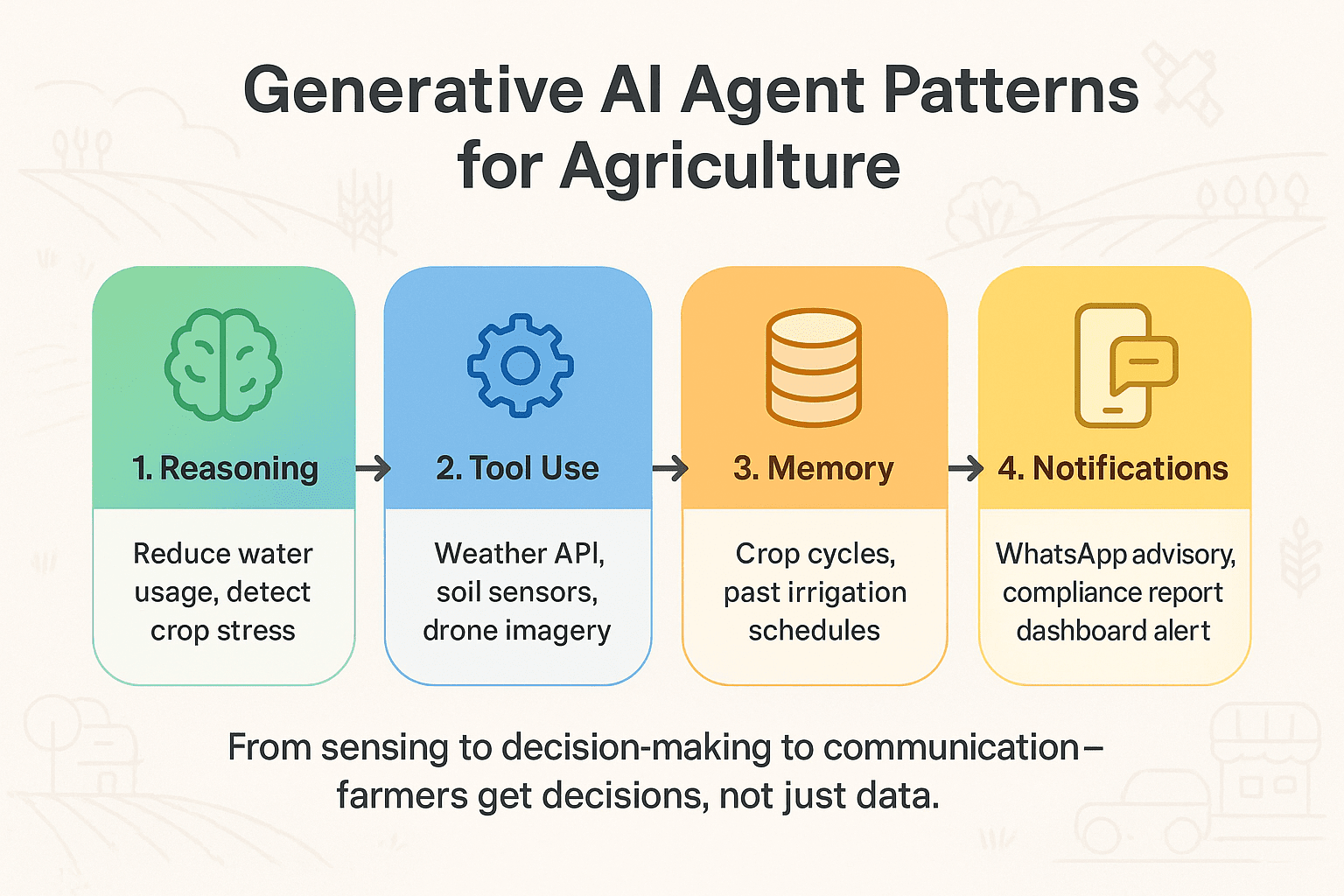
Generative AI agent patterns for agriculture
When building a generative AI agent for agriculture, the design typically follows four core blocks:
Reasoning – Understanding the context and planning actions based on goals (e.g., reducing water use).
Tool Use – Interacting with APIs, IoT platforms, or databases (e.g., pulling data from weather APIs).
Memory – Retaining past interactions and data history to improve recommendations over time (e.g., learning from previous crop cycles).
Notifications – Delivering the output in a useful format, such as WhatsApp messages, compliance reports, or dashboard alerts.
These patterns ensure that generative AI agents don’t just analyze data—they close the loop between sensing, decision-making, and farmer communication.
Why this matters
Farmers don’t need endless dashboards—they need decisions, not just data. A generative AI agent can:
Summarize complex IoT or satellite inputs into clear, actionable advice.
Automate compliance and reporting tasks.
Provide multilingual, personalized guidance at scale.
By adopting these patterns, agriculture businesses can empower farmers with technology that saves time, reduces risk, and improves productivity—all while lowering the complexity of interacting with data-driven systems.
Agriculture domain-specific AI agent flows
AI and generative AI agents create the most impact when they are adapted to specific domains within agriculture. By mapping business needs to automation opportunities, agri-food companies can cut costs, speed up decision-making, and provide new services to farmers. Here’s how various agricultural businesses can apply domain-specific agent flows.
Farm management solutions
Who uses it: Independent farmers, cooperatives, and farm managers.
Automation potential:
Auto-generate weekly crop and finance reports so farmers don’t need to manually compile field notes and expenses.
Task reminders via WhatsApp/Telegram, ensuring daily operations like spraying or planting are not missed.
IoT data summaries that turn complex sensor readings into simple action points.
👉 Impact: Saves time on paperwork, ensures better scheduling, and provides managers with actionable insights instead of raw data overload.
Agro fintech solutions
Who uses it: Rural banks, microfinance providers, crop insurers.
Automation potential:
Automate loan applications by linking farm performance and satellite imagery directly into credit scoring.
AI-generated risk profiles that help lenders assess default risk based on weather and historical yields.
Auto-submit insurance claims using weather or satellite data when droughts, floods, or storms occur.
👉 Impact: Faster access to capital for farmers, reduced admin costs for financial institutions, and fairer insurance processing.
Agronomy advisory services
Who uses it: Agronomists, research institutions, cooperatives.
Automation potential:
Crop recommendation chatbots trained on local conditions.
Pest/disease alerts based on weather forecasts and satellite imagery.
Summarize trial data into simplified farmer guides, making R&D more accessible.
👉 Impact: Bridges the gap between research and field-level practice, ensuring farmers get tailored, timely advice without waiting for field visits.
Input manufacturers & resellers
Who uses it: Seed, fertilizer, pesticide, and equipment suppliers.
Automation potential:
WhatsApp/SMS education agents that teach farmers how to use products correctly.
Auto-match demand with inventory so distributors know where to send stock.
Generate compliance documents in local languages, supporting audits and export requirements.
👉 Impact: Improves product adoption, reduces compliance risks, and helps resellers respond faster to shifting demand.
Precision agriculture solutions
Who uses it: AgTech startups, drone service providers, data analytics firms.
Automation potential:
Satellite health reports with AI-generated insights on crop stress.
Anomaly detection alerts for unusual field patterns.
Input recommendations based on nutrient deficiencies identified by imagery.
👉 Impact: Enables service providers to give actionable guidance, not just raw maps, making precision farming accessible for non-technical farmers.
Agroholdings
Who uses it: Corporate farms, vertically integrated producers, and large cooperatives.
Automation potential:
Dashboards for multi-farm resource allocation, optimizing labor, machinery, and inputs.
ESG and compliance reports auto-generated for regulators and investors.
Employee onboarding agents, offering training and guidance through chat or mobile apps.
👉 Impact: Simplifies management across dozens or hundreds of farms, reduces compliance overhead, and ensures workforce consistency.
Irrigation
Who uses it: Irrigation companies, large farms, and cooperatives in water-stressed regions.
Automation potential:
Soil moisture alerts to prevent under- or over-watering.
Weekly irrigation plans adjusted to crop stages and weather forecasts.
Pump optimization that aligns usage with energy tariffs, reducing costs.
👉 Impact: Cuts water waste, lowers energy bills, and ensures crops get optimal hydration.
Machinery manufacturers
Who uses it: OEMs, dealers, and service providers.
Automation potential:
Summarize maintenance logs for easier tracking.
Predictive maintenance reminders based on sensor data.
Error notifications sent automatically to local dealers for service dispatch.
👉 Impact: Increases machine uptime, strengthens after-sales relationships, and creates new revenue streams through proactive maintenance services.
Implementation roadmap for AI agents
Adopting AI and generative AI agents in agriculture requires more than just installing a model. Success comes from following a structured roadmap that aligns technology with real-world business and farming needs. Below is a practical step-by-step approach for agribusinesses and AgTech providers.
1. Define the use case.
2. Integrate data.
3. Build the agent workflow.
4. Pilot the agent.
5. Scale across operations.