



Why Offline-Capable Mobile Apps Are Still Critical in Agriculture
Modern agriculture is becoming increasingly digital. Farms today rely on mobile applications, IoT devices, GIS systems, livestock tracking platforms, precision agriculture tools, cloud dashboards, and AI-powered recommendations to support daily operations. However, one operational reality still separates agricultural software from traditional business applications: farms do not operate inside stable office environments.

Modern agriculture is becoming increasingly digital. Farms today rely on mobile applications, IoT devices, GIS systems, livestock tracking platforms, precision agriculture tools, cloud dashboards, and AI-powered recommendations to support daily operations. However, one operational reality still separates agricultural software from traditional business applications: farms do not operate inside stable office environments.
Field operations happen across massive territories, remote rural areas, orchards, livestock facilities, underground storage sites, and infrastructure-limited regions where connectivity remains inconsistent or unavailable. While many software products are designed assuming constant cloud access, agriculture often operates under entirely different conditions. In many cases, workers need systems that continue functioning even when there is no internet connection at all.
This is why offline-capable field mobility remains one of the most practical and underrated differentiators in AgTech. Some of the most successful agricultural technology implementations in recent years have not focused only on dashboards or AI models, but on ensuring that field workers can continue operating regardless of network conditions.

Want to build resilient agricultural software that works offline?
Book a consultation with Qaltivate’s AgTech engineering team.
Real-world agricultural case studies from companies like Citrosuco, IBM OpenHarvest and Heifer International, and SoftServe demonstrate that offline-first architecture is not a legacy requirement — it is still a critical operational necessity for modern farming systems.
The challenge itself is global. According to agricultural connectivity research, rural areas continue to face major broadband and infrastructure gaps that directly impact technology adoption. McKinsey identified agriculture as one of the slowest industries to digitize, partly due to infrastructure limitations in rural regions. Additional industry reports show that approximately 18% of U.S. farms still lack internet access, while many farmers globally continue operating without reliable broadband connectivity.
This creates a major engineering challenge for agricultural software companies. Unlike standard SaaS applications, AgTech systems must often support:
- Offline data collection
- Delayed synchronization
- Edge processing
- Bluetooth communication
- SMS-based advisory systems
- Local storage
- Rugged mobile workflows
- Intermittent connectivity
- Low-power environments
The result is that agricultural mobile architecture becomes significantly more complex than traditional enterprise mobile development.
In many industries, temporary internet loss is inconvenient. In agriculture, it can interrupt spraying operations, livestock tracking, harvest logistics, field scouting, or agronomic decision-making. A disconnected tractor, livestock scanner, or field mobility app can directly affect productivity and operational reliability.
This operational pressure is exactly why many large agricultural organizations still prioritize offline-capable systems as a core requirement during digital transformation initiatives.
The importance of this challenge is also increasing due to the expansion of precision agriculture and AI-driven systems. Modern farms now generate data from:
- Satellite imagery
- NDVI monitoring
- Machinery telemetry
- Soil sensors
- Drones
- RFID devices
- Weather integrations
- Autonomous equipment
- Edge AI systems
However, more connected devices do not automatically solve connectivity problems. In many cases, they increase synchronization complexity even further.
According to digital agriculture research, the future of agriculture increasingly depends on distributed digital infrastructure rather than centralized cloud-only systems. This means agricultural software must be designed to operate across hybrid environments where some systems are connected continuously while others only synchronize periodically.
The best agricultural platforms therefore are not simply cloud platforms. They are resilient operational systems that continue functioning under real farm conditions.
This article explores why offline-first architecture remains essential in agriculture through several real-world software engineering case studies:
1. Mobile farm management platform
2. OpenHarvest and Heifer International’s field advisory solution
3. Livestock RFID tracking system
Together, these examples reveal an important reality about modern AgTech: the hardest part of agriculture software is often not analytics or AI. It is building systems reliable enough to operate in the field under unstable real-world conditions.
Why connectivity is still a major problem in agriculture
One of the biggest misconceptions in digital agriculture is the assumption that farms operate inside stable digital environments similar to warehouses, offices, or urban logistics networks. In reality, agriculture remains heavily dependent on rural infrastructure where internet coverage is often inconsistent, unstable, or entirely unavailable.
This challenge affects almost every layer of agricultural operations:
- field scouting
- machinery telemetry
- livestock tracking
- agronomic recommendations
- precision spraying
- irrigation systems
- supply chain coordination
- mobile workforce management
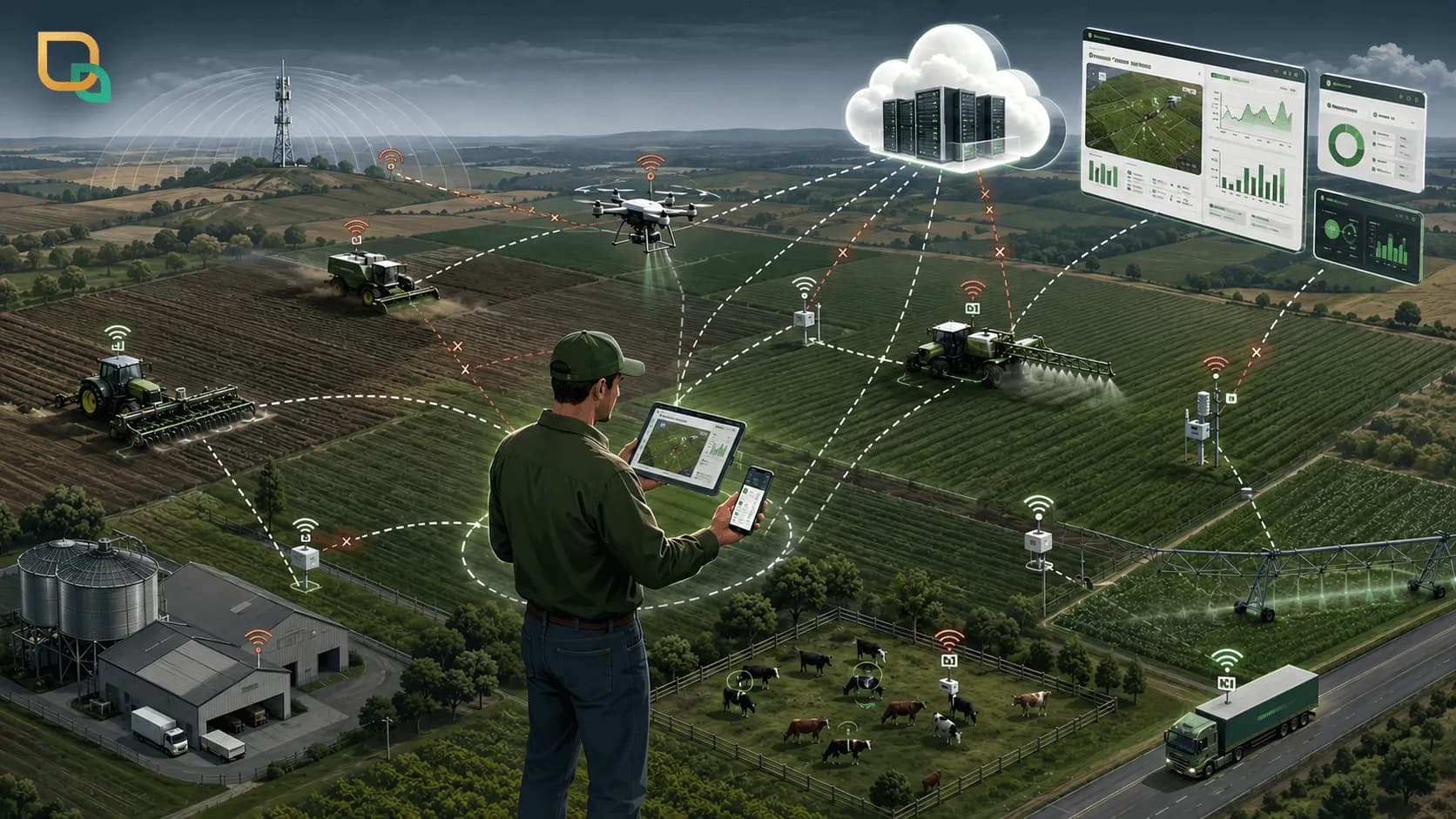
Agriculture is geographically distributed by nature. Operations may span thousands of acres, remote regions, forests, orchards, or mountainous terrain where cellular infrastructure is weak or nonexistent. Even in developed countries, broadband coverage remains a serious operational limitation for farms.
The issue becomes even more critical as agriculture becomes increasingly data-driven. Modern precision farming systems depend on continuous flows of information between:
- mobile applications
- tractors
- IoT devices
- drones
- GIS platforms
- ERP systems
- AI analytics engines
- satellite imagery providers
- livestock monitoring systems
However, unstable connectivity interrupts this operational chain.
In practical terms, connectivity problems create very expensive operational consequences:
- lost field records
- duplicated work
- delayed synchronization
- inaccurate operational reporting
- inability to track assets
- failed uploads from machinery
- inconsistent agronomic recommendations
- synchronization conflicts
- interrupted livestock scanning workflows
These problems may appear technical, but they quickly become business problems.
For example:
- a disconnected spraying operation can lead to skipped acreage
- livestock data synchronization failures can impact traceability
- delayed field reports can affect operational decisions
- unreliable telemetry can reduce machinery utilization efficiency
This is why offline capability is not simply a “feature” in agriculture. It becomes part of operational resilience. The challenge is also deeply tied to the broader rural digital divide. Research on digital agriculture consistently highlights infrastructure limitations as one of the biggest barriers to AgTech adoption. Even advanced precision agriculture technologies struggle to scale if farms cannot maintain reliable connectivity. The problem becomes even more visible in developing agricultural regions. Many agricultural programs across Africa, South America, and Southeast Asia still rely heavily on:
- SMS systems
- delayed synchronization
- offline mobile applications
- local device storage
- community internet hubs
because these technologies remain more operationally reliable than fully cloud-dependent systems.
This explains why some highly successful agricultural initiatives intentionally design around low-connectivity environments instead of assuming modern infrastructure availability. Another important factor is that agricultural work itself is highly mobile. Field workers move constantly between:
- tractors
- livestock facilities
- orchards
- greenhouses
- remote storage facilities
- transportation routes
Connectivity quality may change multiple times during a single operational workflow. A cloud-only system designed for perfect connectivity can therefore become unreliable in real agricultural environments. This is where offline-first architecture becomes a major engineering differentiator. Instead of treating internet loss as an exception, offline-first systems assume intermittent connectivity as part of normal operations. These systems are designed to:
- continue functioning locally
- store data on-device
- synchronize later
- queue operations
- resolve synchronization conflicts
- minimize operational interruptions
This design philosophy is becoming increasingly important as agriculture moves toward:
- autonomous machinery
- edge AI
- precision livestock management
- real-time sensing
- distributed IoT infrastructure
Interestingly, the future of agricultural technology may actually depend more on hybrid connectivity models than on traditional cloud-first approaches. Emerging research on rural 5G and satellite-enabled agriculture shows that future agricultural systems will likely combine:
- local edge computing
- intermittent synchronization
- satellite communication
- cellular networks
- device-to-device communication
- distributed IoT architectures
rather than depending entirely on centralized cloud environments.
In other words, agriculture is forcing software engineering to evolve differently from many traditional industries. The industry does not simply need “more apps.” It needs resilient operational systems capable of functioning in imperfect environments. And this is exactly why offline-capable field mobility continues to be one of the most practical competitive advantages in AgTech today.
Case Study: Offline Mobile Operations Across 28 Farms
One of the clearest examples of why offline-capable agricultural software remains critical comes from Citrosuco — one of the world’s largest orange juice producers. The company operates massive agricultural operations across multiple farms and needed to modernize how field data, operational workflows, and farm management processes were handled across geographically distributed environments.
The challenge was not simply creating a digital dashboard.
The real challenge was ensuring operational continuity across large agricultural territories where workers often operated under unstable connectivity conditions.
The case study demonstrates an important reality in AgTech:
digital transformation in agriculture is often more about operational resilience than about interface design.
Citrosuco implemented a mobile-enabled farm management environment using SAP technologies to support field operations across 28 farms. The initiative focused on improving operational visibility, data collection, machinery management, and field workforce efficiency. The implementation included:
- mobile applications
- GIS integration
- geofencing
- field management tools
- offline operational workflows
- synchronization architecture
Before modernization, many workflows depended heavily on manual processes and disconnected operational systems. Field data often needed to be transferred manually or re-entered later into centralized systems, creating delays, inconsistencies, and operational inefficiencies.
This problem is extremely common across agriculture.
Many farms still struggle with:
- disconnected machinery data
- paper-based workflows
- fragmented operational systems
- delayed reporting
- synchronization issues between field and office teams
For large agricultural organizations, these inefficiencies create major operational blind spots.
Citrosuco’s modernization initiative addressed this problem through mobile field applications capable of supporting operational workflows directly in the field environment. Workers could continue collecting and managing information locally, even when internet access was unavailable, and synchronize data later once connectivity returned.
This approach significantly improved operational continuity.
The implementation also integrated geospatial capabilities into operational management. GIS systems and geofencing allowed the company to improve:
- operational visibility
- field activity tracking
- machinery coordination
- geospatial monitoring
- heatmap-based analytics
The important insight here is that the system was designed around real agricultural conditions rather than ideal cloud conditions.
Many enterprise SaaS platforms assume continuous connectivity because they were originally designed for office-based workflows. Agriculture operates differently. Workers may spend entire days in fields without stable internet access, yet operations must continue uninterrupted.
This is where offline-capable architecture becomes essential.
From a software engineering perspective, building these systems is significantly more difficult than building traditional cloud applications.
An offline-capable agricultural platform requires:
- local device storage
- synchronization logic
- caching systems
- retry mechanisms
- conflict resolution
- geospatial synchronization
- resilient mobile UX
- low-bandwidth optimization
The system must also ensure that operational data remains consistent even after synchronization occurs later.
This engineering complexity is often invisible to end users, but it becomes one of the most important differentiators in agricultural software quality.
The Citrosuco case also demonstrates the growing importance of hybrid operational architectures in agriculture.
Modern agricultural systems increasingly combine:
- mobile field devices
- GIS layers
- cloud platforms
- IoT telemetry
- operational analytics
- ERP systems
However, these environments cannot depend entirely on centralized cloud infrastructure because field operations remain physically distributed.
This is one reason why offline-first agricultural systems continue outperforming many cloud-only AgTech solutions in real operational environments.
The case also reflects broader trends in digital agriculture.
As farms become more data-intensive, organizations increasingly need systems capable of integrating:
- machinery operations
- field labor
- geospatial intelligence
- agronomic workflows
- supply chain coordination
- operational reporting into unified digital ecosystems.
However, integration alone is not enough. The system must remain operational even when connectivity fails. This is exactly where many AgTech platforms still struggle today.
The most successful agricultural systems are often not the most visually advanced platforms. They are the systems capable of delivering operational reliability under real-world agricultural conditions. Citrosuco’s implementation shows that offline-capable mobility is not a secondary feature in agriculture. It is part of the infrastructure required for modern farm operations.
Case Study: IBM OpenHarvest + Heifer International — Offline Advisory Systems for Farmers
Another strong example of offline-capable agricultural software comes from IBM OpenHarvest and Heifer International, which collaborated on digital advisory systems designed specifically for farmers operating in infrastructure-limited regions.
Unlike many modern AgTech products built primarily for large-scale industrial farms with reliable connectivity, this initiative focused on a different reality: millions of smallholder farmers still operate in areas where internet access is inconsistent, smartphones are limited, and digital infrastructure remains underdeveloped.
Source: IBM + Heifer International case study
The project aimed to improve agricultural decision-making and farmer support through a combination of:
- Mobile field applications
- SMS communication systems
- AI-powered recommendations
- Weather integrations
- Offline data collection
- Cloud-based agricultural analytics
The operational challenge was not simply creating a digital platform. The real challenge was delivering useful agricultural guidance in regions where connectivity limitations made traditional cloud-first applications unreliable.
Field facilitators often traveled between remote farming communities collecting information manually, helping farmers with crop recommendations, and distributing agronomic guidance. However, disconnected workflows and limited infrastructure made data collection and communication difficult.
To solve this problem, IBM OpenHarvest and Heifer International designed systems capable of supporting delayed synchronization and low-connectivity communication channels.
Field facilitators could collect farmer data locally through mobile applications while operating offline. Once connectivity became available later, the information synchronized back into centralized cloud systems.
At the same time, the platform delivered recommendations to farmers using SMS messaging, which remained significantly more reliable than smartphone applications in many rural regions.
This is an important insight often overlooked in AgTech.
In many agricultural markets, the most effective digital solutions are not necessarily the most technologically advanced interfaces. They are the systems designed around the actual operational realities of the users.
For many rural agricultural environments, SMS communication remains more dependable than cloud-native mobile applications requiring continuous internet access.
The platform also integrated environmental and agronomic information such as:
- Weather data
- Crop recommendations
- Localized agricultural insights
- Farmer operational records
These recommendations helped farmers make better operational decisions while enabling organizations to collect more structured agricultural data across distributed farming communities.
From a software engineering perspective, the complexity of this system was far greater than building a traditional SaaS dashboard.
The platform needed to support:
- Offline synchronization
- Mobile-first workflows
- Low-bandwidth communication
- Distributed data collection
- SMS integrations
- Localized recommendation delivery
- Cloud synchronization architecture
The case demonstrates how agricultural software architecture must often adapt to infrastructure constraints rather than assuming ideal operating conditions.
It also reflects a broader trend in digital agriculture: operational accessibility is becoming just as important as analytics capabilities.
Many AgTech platforms fail not because the technology itself is weak, but because the systems are not designed around the environments where agricultural work actually happens.
The IBM OpenHarvest and Heifer International case shows that offline-capable agricultural systems are not simply about convenience. They are often the only practical way to enable digital agriculture adoption at scale in infrastructure-constrained environments.
Want to improve farmer engagement through mobile and SMS solutions?
Qaltivate creates scalable agricultural communication systems and digital advisory platforms.
Case Study: RFID Livestock Tracking — Offline Bluetooth and Cloud Synchronization
Another example of offline-capable agricultural engineering comes from SoftServe’s RFID-based livestock management solution, which demonstrates how agricultural systems often need to combine mobile devices, embedded hardware, Bluetooth communication, and delayed cloud synchronization into a single operational workflow.
Source: SoftServe RFID livestock tracking case study
The project focused on solving livestock tracking and animal identification challenges in real agricultural field conditions where connectivity was unreliable and operational continuity was critical.
Modern livestock operations increasingly depend on digital traceability systems for:
- Animal identification
- Health monitoring
- Movement tracking
- Regulatory compliance
- Operational analytics
- Inventory management
However, livestock environments create major engineering challenges for digital systems.
Workers often operate in remote areas with unstable connectivity while needing immediate access to operational records and rapid animal identification capabilities.
SoftServe addressed this challenge by developing a livestock management workflow that combined:
- RFID hardware
- Bluetooth communication
- Mobile applications
- Cloud synchronization
- Embedded device integrations
- OTA firmware updates
The operational workflow was designed specifically around low-connectivity agricultural environments.
RFID devices scanned livestock identification tags locally in the field. Data transferred through Bluetooth communication into mobile applications without requiring immediate internet access.
The mobile application stored operational information locally and synchronized records back into cloud systems later once connectivity became available.
This architecture allowed field operations to continue uninterrupted even during internet outages.
The case highlights an important reality in agricultural software development: cloud-only architecture is often insufficient for real-world farming operations.
Many agricultural systems must instead operate as hybrid environments that combine:
- Edge devices
- Mobile applications
- Embedded systems
- Bluetooth communication
- Offline local storage
- Periodic cloud synchronization
Building these systems introduces significantly more engineering complexity than standard enterprise mobile development.
The platform needed to handle:
- Offline state management
- Bluetooth reliability
- Synchronization conflicts
- Local caching
- Telemetry buffering
- Embedded device communication
- Delayed synchronization workflows
These technical requirements become especially important in agriculture because operational delays can directly impact animal management, compliance tracking, and farm productivity.
The case also reflects a larger trend toward edge computing in agriculture.
As farms deploy more IoT devices, RFID systems, sensors, and autonomous equipment, agricultural platforms increasingly need to process and store information closer to the operational environment instead of depending entirely on centralized cloud systems.
This shift is becoming one of the defining architectural patterns in modern AgTech.
The SoftServe livestock management case demonstrates that offline-capable mobility is no longer only about convenience for field workers. It is becoming foundational infrastructure for precision livestock operations and connected agricultural systems.
Need agricultural systems that continue working without internet access?
Qaltivate develops resilient mobile and edge solutions for field operations and remote agricultural environments.
-card-640x480.webp&w=3840&q=75&dpl=dpl_2F3RrRGAaY33MNURi632dkspcWvZ)
-card-640x480.webp&w=3840&q=75&dpl=dpl_2F3RrRGAaY33MNURi632dkspcWvZ)
-card-640x480.webp&w=3840&q=75&dpl=dpl_2F3RrRGAaY33MNURi632dkspcWvZ)