


Agriculture IoT Platform Development: Architecture, Costs, and Key Features
Agriculture is becoming increasingly connected. Sensors, smart machinery, livestock monitoring devices, drones, and satellite technologies are generating more farm data than ever before. At the same time, farmers and agribusinesses are under pressure to improve productivity, reduce costs, and make faster operational decisions. The adoption of precision agriculture has accelerated this shift.

Agriculture is becoming increasingly connected. Sensors, smart machinery, livestock monitoring devices, drones, and satellite technologies are generating more farm data than ever before. At the same time, farmers and agribusinesses are under pressure to improve productivity, reduce costs, and make faster operational decisions.
The adoption of precision agriculture has accelerated this shift. Modern farms can now monitor soil conditions, weather patterns, equipment performance, animal health, and crop development in near real time. However, collecting data is only one part of the equation.
Many agricultural businesses struggle with fragmented information spread across multiple devices, software platforms, and data sources. Valuable insights often remain trapped in spreadsheets, disconnected applications, or individual equipment systems. As a result, decision-makers may have access to large volumes of data but limited visibility into what actions should be taken next.
This challenge has created growing demand for the agriculture IoT platform.
An agriculture IoT platform serves as the central nervous system of a connected farming operation. It collects data from sensors, machinery, livestock tracking systems, weather stations, and other digital tools. The platform then transforms that information into dashboards, alerts, reports, and recommendations that support daily operations.
Whether the goal is monitoring irrigation systems, tracking livestock, optimizing equipment usage, or improving crop performance, a modern agriculture IoT platform provides a single environment for managing farm data and turning it into actionable intelligence.
In this guide, we explore how agriculture IoT platform development works, the architecture behind these systems, the key features businesses should prioritize, and the costs involved in building a scalable solution.
What is an agriculture IoT platform?
An agriculture IoT platform is a software system that connects devices, equipment, and data sources used across farming operations into a single operational environment. Instead of managing information through separate applications, farms can monitor and control their operations from one centralized platform.
A modern agriculture IoT platform typically collects data from:
- Soil and environmental sensors
- Agricultural machinery and equipment
- Livestock monitoring devices
- Weather stations
- Drones and aerial imaging systems
- Satellite data providers
- Farm management software and business systems
The platform continuously gathers information from these sources and transforms it into meaningful insights. Farmers, agronomists, ranch managers, and agricultural businesses can then use this information to make faster and more informed decisions.
For example, a livestock operation may combine RFID tracking data, animal health records, weather conditions, and pasture information within a single agriculture IoT platform. This creates a complete view of herd performance without switching between multiple systems.
At its core, an agriculture IoT platform serves as the foundation of connected farming. It enables data collection, device communication, analytics, automation, and decision support across the entire operation.
Most agriculture IoT platforms follow a similar data flow:
Device → Gateway → Cloud → Analytics → Dashboard → Action
- Devices collect information from the field.
- Gateways transmit data from remote locations.
- Cloud infrastructure stores and processes data.
- Analytics engines identify trends and anomalies.
- Dashboards present information to users.
- Actions trigger decisions, alerts, or automated responses.
Without an agriculture IoT platform, farms often operate with disconnected data sources and limited visibility. With the right platform in place, agricultural businesses can transform raw data into actionable intelligence that supports productivity, efficiency, and long-term growth.
Types of agriculture IoT platforms
Not all agriculture IoT platforms are built for the same purpose. Some focus on crop production, while others specialize in livestock management, irrigation, equipment monitoring, or sustainability initiatives.
The type of platform a business needs depends on its operational goals, available data sources, and the decisions it wants to improve. Many modern agriculture IoT platforms combine several capabilities into a single solution, creating a unified view of farm operations.
The table below outlines the most common types of agriculture IoT platforms and their primary use cases.
Platform Type | Primary Purpose |
|---|---|
Precision Farming Platform | Monitor crop health, field conditions, and production performance |
Livestock Monitoring Platform | Track animal location, health, breeding, and herd performance |
Smart Irrigation Platform | Optimize water usage and automate irrigation decisions |
Greenhouse Automation Platform | Manage climate, humidity, lighting, and growing conditions |
Machinery Telematics Platform | Monitor equipment location, utilization, maintenance, and fuel consumption |
Carbon Farming Platform | Measure sustainability metrics, emissions, and carbon sequestration activities |
Precision farming platforms
Precision farming platforms help growers collect and analyze data from sensors, drones, satellites, and machinery. Their primary goal is improving crop performance while reducing input costs.
Typical capabilities include yield monitoring, field mapping, variable-rate applications, and crop health analysis.
Livestock monitoring platforms
Livestock IoT platforms focus on animal management. They often combine RFID tags, GPS devices, wearable sensors, and mobile applications to provide visibility into herd operations.
These platforms help producers monitor animal health, track movements, manage breeding programs, and maintain compliance records.
Smart irrigation platforms
Water is one of agriculture’s most valuable resources. Smart irrigation platforms use soil moisture sensors, weather data, and automation systems to determine when and how much water should be applied.
The result is more efficient water use and improved crop performance.
Greenhouse automation platforms
Controlled environment agriculture relies heavily on real-time monitoring and automation. Greenhouse platforms help operators manage temperature, humidity, ventilation, lighting, and nutrient delivery systems from a single interface.
Machinery telematics platforms
Modern agricultural equipment generates large volumes of operational data. Machinery telematics platforms collect information from tractors, harvesters, sprayers, and other assets to improve utilization and maintenance planning.
Carbon farming platforms
As sustainability reporting becomes more important, carbon farming platforms are gaining attention across the agricultural sector. These solutions collect operational, environmental, and geospatial data to support carbon accounting, emissions tracking, and regenerative agriculture initiatives.
Many organizations also use these platforms to support carbon credit programs and sustainability reporting requirements.
While each platform category addresses different challenges, the most successful agriculture IoT platforms often integrate multiple functions into a single ecosystem. This approach eliminates data silos and provides a more complete picture of farm operations.
Agriculture IoT platform architecture
A successful agriculture IoT platform is much more than a dashboard. Behind every recommendation, alert, or report is a complex architecture that collects, processes, and transforms data into actionable insights.
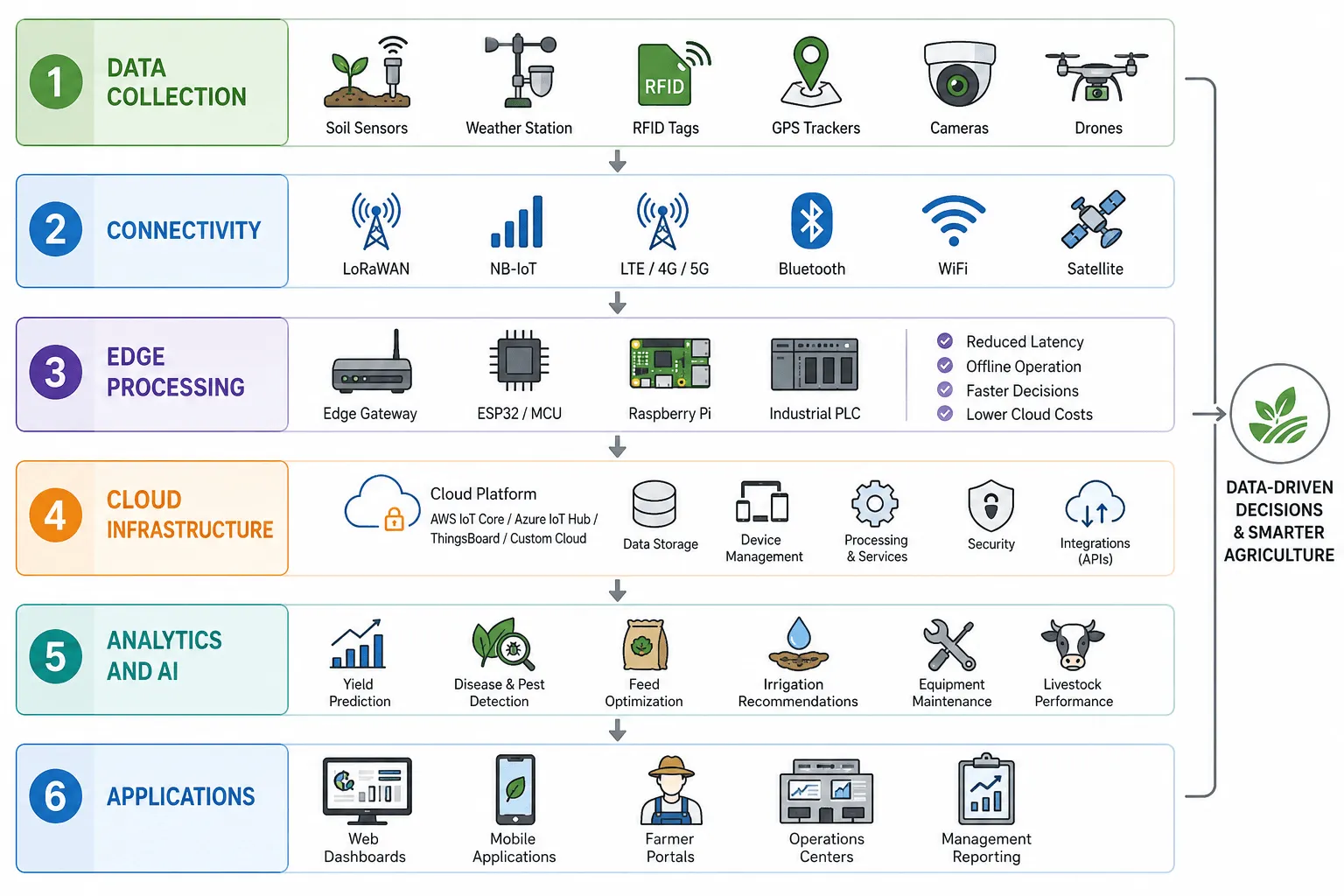
While every project has unique requirements, most agriculture IoT platforms follow a similar architecture built around six core layers.
Layer 1: Data collection
Everything begins with data collection. This layer consists of the physical devices and systems that generate information from the field.
Common data sources include:
- RFID tags and readers
- Soil moisture and nutrient sensors
- Weather stations
- GPS trackers
- Camera systems
- Drones and aerial imagery
Depending on the operation, thousands of devices may be collecting data simultaneously. Crop farms often focus on field conditions and machinery data, while livestock operations may prioritize animal tracking and health monitoring.
The quality of the entire agriculture IoT platform depends on the quality of the data collected at this stage.
Layer 2: Connectivity
Once data is collected, it must be transmitted to a central platform. Choosing the right communication technology is one of the most important architectural decisions.
Several connectivity options are commonly used in agriculture:
Technology Typical Use Case
LoRaWAN Long-range communication for remote fields with low power consumption
NB-IoT Sensor networks that require cellular coverage and low bandwidth
LTE/4G/5G High-volume data transmission and machinery connectivity
Bluetooth Short-range communication between local devices
WiFi Farm buildings, greenhouses, and nearby equipment
Satellite Remote locations without reliable cellular coverage
In many cases, agriculture IoT platforms use multiple communication methods at the same time. A livestock operation may rely on LoRaWAN for animal tracking while using LTE to synchronize data with cloud services.
Layer 3: Edge processing
Sending every data point directly to the cloud is not always practical. Farms often operate in areas with limited connectivity, and some decisions must be made immediately.
This is where edge computing becomes important.
Common edge processing devices include:
- ESP32 microcontrollers
- Raspberry Pi devices
- Industrial PLCs
- Edge gateways
Instead of sending raw data to the cloud, these devices process information locally before transmitting only the most relevant insights.
Benefits of edge processing include:
- Reduced latency
- Faster response times
- Offline operation
- Lower cloud infrastructure costs
- Improved reliability in remote environments
For example, an irrigation controller can make watering decisions locally even if internet connectivity is temporarily unavailable.
Layer 4: Cloud infrastructure
The cloud layer serves as the central hub of the agriculture IoT platform. It stores data, manages devices, processes information, and supports integrations with other business systems.
Popular cloud technologies include:
AWS IoT Core
Azure IoT Hub
ThingsBoard
Custom cloud architectures built on AWS, Azure, or Google Cloud
This layer is responsible for handling large volumes of agricultural data while ensuring scalability, security, and reliability.
It also enables integrations with farm management software, ERP systems, analytics tools, and mobile applications.
Layer 5: Analytics and AI
Data becomes valuable when it helps people make better decisions. The analytics layer transforms raw information into actionable intelligence.
Modern agriculture IoT platforms often use artificial intelligence and machine learning to identify patterns that would be difficult to detect manually.
Common use cases include:
Yield prediction
Disease and pest detection
Feed optimization
Irrigation recommendations
Equipment maintenance forecasting
Livestock performance analysis
Rather than simply reporting what happened, advanced agriculture IoT platforms help predict what is likely to happen next.
Layer 6: Applications
The final layer is where users interact with the platform.
Information is delivered through applications designed for different stakeholders across the agricultural operation.
Common interfaces include:
Web dashboards
Mobile applications
Farmer portals
Operations centers
Management reporting systems
These applications provide access to real-time data, alerts, analytics, and automation controls. Their goal is to present complex agricultural information in a format that supports faster and more confident decision-making.
When all six layers work together, an agriculture IoT platform becomes more than a data collection tool. It becomes a connected digital ecosystem that supports operational efficiency, automation, and data-driven agriculture at scale.
Key features of a modern agriculture IoT platform
The value of an agriculture IoT platform is not determined by the number of connected devices. It is determined by how effectively the platform helps users make decisions, automate operations, and improve performance.
While every agricultural business has different requirements, several features have become standard in modern agriculture IoT software:
Real-time monitoring
One of the most important features of an agriculture IoT platform is real-time visibility. Instead of waiting for manual reports, users can monitor field conditions, equipment performance, livestock activity, and environmental data as it happens.
This allows operators to identify problems before they become costly disruptions.
GPS tracking
GPS tracking provides visibility into the location of machinery, vehicles, equipment, and livestock. It helps agricultural businesses optimize routes, reduce asset loss, and improve operational coordination.
For large farming operations, location data often becomes a critical part of daily decision-making.
Predictive analytics
Modern agriculture IoT platforms go beyond historical reporting. Predictive analytics uses historical and real-time data to forecast future outcomes.
Common applications include:
- Yield forecasting
- Disease risk prediction
- Feed planning
- Equipment maintenance forecasting
- Irrigation optimization
These capabilities help businesses make proactive rather than reactive decisions.
Alerts and notifications
Agricultural operations cannot be monitored manually around the clock. Automated alerts notify users when predefined conditions occur.
Examples include:
- Low soil moisture levels
- Equipment failures
- Temperature fluctuations
- Livestock health anomalies
- Water system malfunctions
Immediate notifications help reduce losses and improve response times.
Mobile access
Many agricultural activities happen far from the office. Mobile applications allow users to access the agriculture IoT platform directly from the field.
Farm managers, technicians, agronomists, and ranch workers can review data, update records, and receive alerts without returning to a desktop workstation.
RFID integration
RFID technology plays an important role in livestock management and traceability programs. A modern agriculture IoT platform should support RFID readers, electronic identification systems, and animal tracking workflows.
This functionality simplifies recordkeeping and improves visibility across the livestock lifecycle.
Reporting and compliance
Agricultural businesses often need to demonstrate compliance with industry regulations, sustainability programs, food safety requirements, or customer standards.
Built-in reporting tools help automate data collection and generate reports for audits, certifications, and operational reviews.
AI recommendations
Artificial intelligence is becoming a key differentiator for agriculture IoT platforms. Instead of simply displaying data, AI-powered systems can recommend actions based on patterns detected across multiple data sources.
Examples include recommending irrigation schedules, identifying health risks in livestock, optimizing fertilizer applications, or prioritizing maintenance activities.
As agriculture becomes increasingly data-driven, AI recommendations help transform information into practical actions that improve efficiency and profitability.
Together, these features turn an agriculture IoT platform from a data collection system into a decision-support platform capable of improving productivity, reducing operational risk, and supporting long-term business growth.

Get a custom agriculture platform estimate
Send us your requirements
-card-640x480.webp&w=3840&q=75&dpl=dpl_G8cMt5uKKgmtzLt9vdHLhKunCvij)
-card-640x480.webp&w=3840&q=75&dpl=dpl_G8cMt5uKKgmtzLt9vdHLhKunCvij)
-card-640x480.webp&w=3840&q=75&dpl=dpl_G8cMt5uKKgmtzLt9vdHLhKunCvij)