


Smart Spraying: How AI Finds Weeds and Cuts Herbicide
Learn how smart spraying uses cameras and AI to spot weeds and spray only them, from detection models and edge processing to what it takes to build a system.

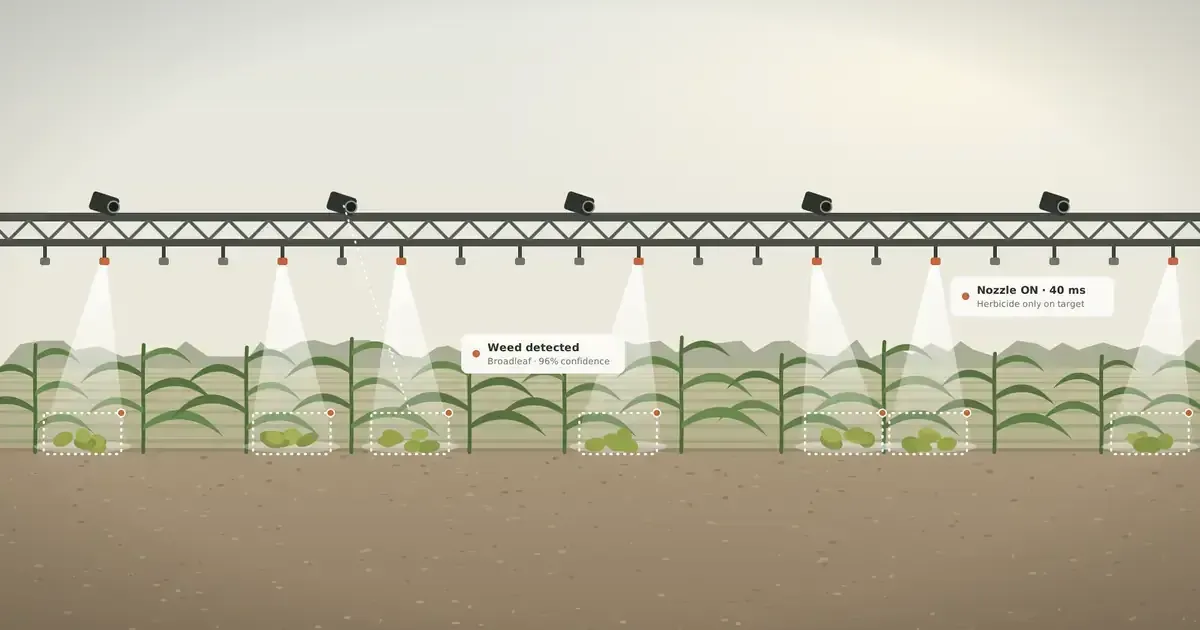
Smart spraying is a precision agriculture method that uses cameras and artificial intelligence to find weeds in a field and spray herbicide only on them, instead of covering every square foot. It is also called see-and-spray, spot spraying or targeted spraying.
The technology has moved from trials to scale. In 2025, John Deere customers used See & Spray on more than 5 million acres, cut non-residual herbicide use by nearly 50% on average, and saved close to 31 million gallons of herbicide mix.
This guide explains how AI weed detection works: the cameras on the boom, the detection models, why processing happens on the sprayer itself, and what it takes to build a smart spraying system.
What is smart spraying?
Smart spraying is targeted herbicide application driven by real-time weed detection. Cameras on the sprayer boom capture images of the ground ahead, an AI model identifies weeds, and individual nozzles open only above them. The result is the same weed control as broadcast spraying with far less chemical, cost and environmental load.
Spot spraying vs. broadcast spraying
Broadcast spraying applies one rate across the whole field, whether a weed is present or not. Spot spraying treats each weed individually. Because weeds usually cover a small fraction of a field, most of a broadcast application lands on crop or bare soil. Smart spraying removes that waste and makes it practical to use more expensive or more effective products only where they are needed.
Green-on-brown vs. green-on-green
Smart spraying systems fall into two groups, depending on what they must tell apart:
Type | What it detects | Typical technology | Example systems |
|---|---|---|---|
Green-on-brown | Green weeds on bare soil or residue, before planting or after harvest | Optical sensors, color detection, chlorophyll fluorescence | See & Spray Select, WeedSeeker 2, WEED-IT Quadro |
Green-on-green | Weeds growing inside a green crop | RGB or multispectral cameras with AI models | See & Spray Ultimate, Greeneye, ONE SMART SPRAY, Bilberry, Ecorobotix ARA |
Green-on-brown is the easier problem, because any green plant is a target. Green-on-green requires AI weed detection that separates weed species from crop plants by shape, texture and position.
How see-and-spray technology works
See-and-spray technology works as a fast loop that repeats many times per second across the whole boom: capture an image, detect weeds, decide which nozzles to fire, open the valves, and record what was sprayed. Every step has to finish before the boom passes over the plant it saw.
- Capture. Cameras spaced along the boom photograph the strip of ground ahead of the nozzles.
- Detect. An onboard AI model finds plants in each frame and classifies them as crop or weed.
- Decide. Software maps each weed's position to the nozzle that will pass over it, using travel speed and GNSS position.
- Spray. Individually controlled nozzles open for a few milliseconds above each weed.
- Record. The system logs detections and applications, which become weed maps and as-applied records.
- John Deere's See & Spray Ultimate shows the scale involved: 36 cameras mounted about one meter apart on a 120-foot boom, scanning more than 2,100 square feet at once while driving up to 12 mph.
Camera and sensor hardware for smart sprayers
Smart sprayers use rugged industrial cameras mounted on the boom, usually standard RGB cameras, sometimes with multispectral or fluorescence sensors. The hardware has to capture sharp images at speed, in dust, vibration and changing light, and pass them to the onboard computer without delay.
Camera types
- RGB cameras are the most common choice for green-on-green detection. They capture shape and texture detail that AI models need to tell species apart.
- Multispectral cameras add near-infrared bands that separate living plants from soil and residue more reliably.
- Chlorophyll fluorescence and optical sensors detect any green plant very quickly and cheaply, which suits green-on-brown applications.
What makes field imaging hard
- Motion blur: at spraying speed, cameras need short exposure times and fast global shutters.
- Lighting: shadows from the boom, low sun and cloud changes alter colors. Some systems add LED lighting so they can also run at night.
- Boom movement: the boom bounces and sways, changing the camera's height and angle. Boom height control helps keep images consistent.
- Dust, spray drift and mud on lenses, which call for protective housings and cleaning routines.
Nozzle control
Detection is useless without precise actuation. Smart sprayers use fast solenoid valves on each nozzle, often driven by pulse-width modulation, so each nozzle can switch on and off independently. The spray controller receives commands from the vision system and must time each valve to the travel speed so the droplets land on the weed, not behind it.
AI weed detection models
AI weed detection uses deep learning models, usually real-time object detectors or segmentation networks, trained on thousands of labeled field images to locate each plant and classify it as crop or a specific weed. The model must be both accurate and fast enough to run on embedded hardware on the sprayer. For a broader overview, see our guide to computer vision in agriculture.
Detection, segmentation or classification
- Object detection (for example the YOLO family or RT-DETR) draws a box around each plant and labels it. It is fast and the most common choice for spraying.
- Semantic segmentation labels every pixel as crop, weed or soil. It gives precise shapes but needs more computing power.
- Image classification labels a whole image tile. It is simple but cannot place individual weeds as precisely.
What the research shows
A 2025 study compared YOLOv8, YOLOv9, YOLOv10 and RT-DETR models on 5,611 field images covering three crops and 13 weed species. Its findings are useful for anyone building a weed detection model:
- YOLOv9s gave the best balance, reaching 79.86% mAP50 when weeds were grouped into broadleaf (dicot) and grass (monocot) classes.
- Grouping weeds by type instead of by species improved accuracy and recall, which matters because a spraying decision often only needs to know "weed or crop."
- RT-DETR-l had the highest precision, so it suits cases where false positives are costly.
- The smallest model, YOLOv8n, processed a frame in about 7.6 ms on a desktop GPU, making small models the natural candidates for embedded hardware.
Precision vs. recall: the business trade-off
Every weed detection model trades missed weeds against unnecessary sprays. A model tuned for high recall catches nearly every weed but sprays more crop. A model tuned for high precision saves more herbicide but lets some weeds survive. Most commercial systems let the operator set a sensitivity level, so the trade-off becomes an agronomic decision per field, not just a technical one. Learn more about how machine learning in agriculture handles these decisions.
Why processing happens on the sprayer: edge AI
Weed detection runs on computers mounted on the sprayer, not in the cloud, because the decision must be made in a fraction of a second and fields rarely have reliable connectivity. This is edge AI: the model runs where the data is captured.
The time budget is tight. At 12 mph, a sprayer travels about 5.4 meters per second. If a camera looks one meter ahead of the nozzles, the system has under 190 milliseconds to capture the frame, run the model, compute the timing and open the valve. A round trip to a cloud server is not an option.
Edge hardware
Smart sprayers typically use embedded GPU modules or industrial edge computers, often one processor shared by a few cameras. The hardware must survive heat, cold, vibration and dust, and run on the machine's power supply. Our guide to AI on edge devices in agriculture covers hardware options in more detail.
Making models fast enough
- Quantization converts model weights to lower precision, such as INT8, for faster inference with little accuracy loss.
- Pruning and smaller architectures remove unnecessary capacity from the network.
- Hardware-specific runtimes compile the model for the exact chip on the sprayer.
- Region-of-interest processing skips image areas with no vegetation before running the full model.
The cloud still plays a role, just not in the spray decision. Data uploads when the machine is back in coverage, and model updates download the same way, the same pattern used by offline-capable agriculture apps.
How much herbicide does smart spraying save?
Smart spraying typically cuts non-residual herbicide use by 50% to 90%, depending on weed pressure, crop stage and the system used. Fields with sparse weeds see the largest savings. Reported results from manufacturers and trials:
System | Reported result |
|---|---|
John Deere See & Spray (all customers, 2025) | Nearly 50% average reduction in non-residual herbicide across 5M+ acres |
Greeneye Technology (UNL trial, 2022) | 87% less non-residual herbicide post-emergence, 94% less burndown herbicide, $65.10/acre saved |
Bosch BASF ONE SMART SPRAY | Up to 70% herbicide volume savings in trials |
In the UNL trial, weed control matched broadcast spraying for broadleaf weeds (96.3% control) and was slightly lower for grasses (89.6% vs. 93%). Results like these are why detection accuracy for specific weed groups matters as much as headline savings.
How to build a smart spraying system
Building a smart spraying system means combining four parts that rarely come from one team: rugged imaging hardware, a weed detection model, real-time edge software, and integration with the sprayer's controls. Most projects follow seven stages.
- Define the use case. Green-on-brown or green-on-green, which crops, which weeds, what travel speed and boom width. This sets every later requirement.
- Collect and label data. Gather images across fields, growth stages, soils, weather and light. Labeling is often the largest cost, and dataset diversity decides how well the model performs in new regions.
- Select and train the model. Start from a proven real-time architecture, then tune for the precision and recall your agronomy requires.
- Optimize for the edge. Quantize and compile the model for the target hardware, and test latency at full field speed.
- Integrate with the sprayer. Connect to nozzle valves, the spray controller, GNSS and speed sensors. For retrofits, design for multiple sprayer brands through standards such as ISOBUS.
- Validate in the field. Measure detection accuracy, weed control and herbicide savings against broadcast check strips across a full season.
- Build the data platform. Turn detections into weed maps, as-applied records and reports, and push model updates back to machines.
Common challenges
- Generalization: a model trained in one region often loses accuracy elsewhere, because weeds, soils and crop varieties differ.
- Small weeds and overlapping plants are the hardest to detect, yet early-stage weeds are the most important to control.
- Timing accuracy: small errors in speed or latency move the spray off target.
- Product labels: spot application must still follow herbicide label requirements in each market.
- Hardware durability: electronics must survive a full season of vibration, chemicals and weather.
Team and cost
A typical team combines computer vision engineers, embedded and edge developers, a data labeling operation, agronomists, and backend developers for the data platform. Many agtech companies start with a focused proof of concept on one crop and one weed group, then expand. Our guides on choosing an MVP development company for AgTech and agriculture software development costs explain how to scope that first phase. Connecting sprayers, sensors and cloud services follows the same patterns as an agriculture IoT platform.
Beyond spraying: weed maps and field data
Every pass of a smart sprayer produces a detailed map of where weeds grow. That data has value after the spray is done. Weed maps show resistant patches, guide residual herbicide plans, and feed variable-rate technology for the next season. Combined with drone imagery for scouting, they let agronomists plan treatments before the sprayer even enters the field.