


Agriculture Fleet Management: How Farms Track Equipment, Cut Fuel Costs and Avoid Harvest Downtime
Agriculture fleet management helps farms track tractors, combines and trucks in one system. Learn how telematics, fuel tracking and engine-hour maintenance cut diesel costs, prevent equipment theft and keep machines running through harvest, plus what fleet software costs and how to choose it.

Agriculture fleet management is the practice of tracking, maintaining and scheduling every vehicle and machine a farm runs, from pickups and grain trucks to tractors, combines and sprayers, using telematics and software. Done well, it cuts three of the biggest costs on any operation: fuel, unplanned downtime and lost or stolen equipment.
A farm fleet is not a delivery fleet. It mixes road trucks with off-road machinery, works in fields with weak cell coverage, and faces its heaviest load in a few weeks of planting and harvest. This guide explains how agricultural fleet management works, what it costs, and how to choose software that fits row-crop farms, ranches, dairies, co-ops and custom harvesters.
What is agriculture fleet management?
Agriculture fleet management is a system for knowing where every farm vehicle and machine is, how hard it is working, how much fuel it burns and when it needs service. It combines GPS and telematics devices, fleet management software, and the people who plan field work and maintenance. The goal is more productive hours from the same equipment at a lower cost per acre.
What counts as a farm fleet
A farm fleet includes anything with an engine or a value worth tracking:
- Road vehicles: pickups, service trucks, grain and livestock trucks, semi tractors
- Self-propelled machinery: tractors, combines, forage harvesters, sprayers, windrowers
- Utility vehicles: ATVs, UTVs, telehandlers, skid steers
- Unpowered assets: trailers, grain carts, planters, tillage implements, fuel and water tanks
Who manages a farm fleet
On a family farm, the owner-operator usually manages the fleet alongside everything else. On large operations, co-ops and custom harvesting businesses, a shop manager or dedicated fleet manager owns maintenance, fuel and equipment logistics. Ag fleet management software helps both by putting the data in one place instead of in notebooks and memory.
How farm fleets differ from commercial truck fleets
Farm fleets differ from commercial truck fleets in five ways: they mix on-road and off-road equipment, measure use in engine hours, peak sharply in planting and harvest, operate in rural dead zones, and run machinery from several brands. Fleet tools built only for delivery vans miss most of this.
Factor | Commercial truck fleet | Agricultural fleet |
|---|---|---|
Equipment | Similar trucks and vans | Trucks plus tractors, combines, sprayers and implements |
Usage measure | Miles | Engine hours for machinery, miles for trucks |
Workload | Steady year-round | Seasonal peaks in planting and harvest |
Coverage | Mostly on highways and in towns | Remote fields with weak or no cell signal |
Brands | Few makes | John Deere, Case IH, New Holland, AGCO and others side by side |
Mixed fleets: trucks and machinery in one system
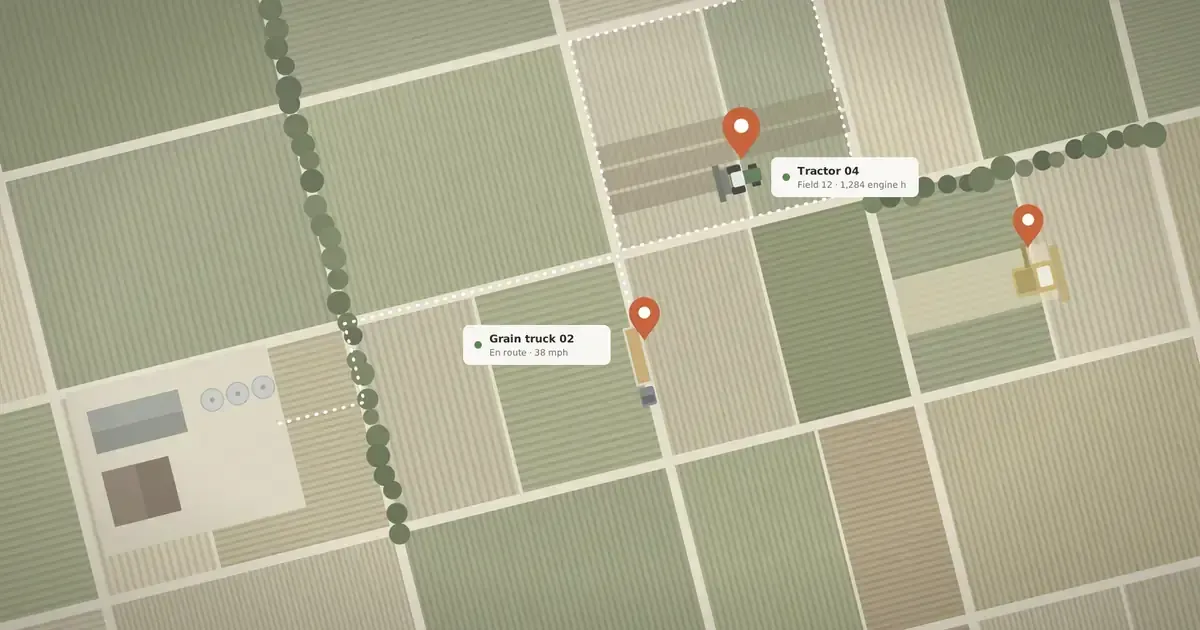
Most farms run a mixed fleet, and that is where heavy equipment fleet management and truck tracking need to meet. A grain truck waiting at the field edge and a combine with a full hopper are one logistics problem. A system that shows both on one map lets the manager line up trucks and grain carts without radio calls.
Seasonality and the harvest window
A delivery fleet loses a day of revenue when a van breaks down. A farm can lose yield and grain quality when a combine sits idle for three days in a narrow harvest window. That is why agricultural fleet management puts more weight on pre-season readiness and fast repairs than on day-to-day route efficiency.
Benefits of fleet management for farms
The main benefits of an agriculture fleet management solution are lower fuel spend, fewer breakdowns at critical times, longer machine life and better protection against theft. The six that matter most:
- Lower fuel costs. Idle time, unauthorized use and tank losses become visible and fixable.
- Less downtime. Service is scheduled by actual engine hours, and fault codes reach the shop before a machine fails.
- Longer equipment life. On-time maintenance protects engines, transmissions and hydraulics.
- Theft prevention and recovery. Geofences and after-hours alerts flag movement, and GPS shows where a machine went.
- Better labor and logistics. Managers see which field each crew is in and which machines are free.
- Cleaner records. Automatic hour, fuel and service logs support compliance, insurance claims and higher resale values.
How telematics tracks tractors and farm equipment
Telematics tracks farm equipment through a device connected to the machine's engine and GPS. It records location, engine hours, fuel use and diagnostic codes and sends them to fleet software over cellular or satellite networks. Telematics for fleet management turns each tractor or truck into a data source the manager can check from a phone.
What telematics collects
- Live location and travel history
- Engine hours, split into working, transport and idle time
- Fuel level and fuel burn rate
- Engine and machine fault codes
- Speed, ignition on/off and after-hours use
- Implement and auxiliary inputs on supported machines, such as PTO use
Machine utilization reports break each tractor's hours into work, transport and idle categories, so managers can see how much time actually goes to field work (RDO Equipment).
OEM telematics vs. aftermarket trackers
Most new machinery ships with factory telematics, such as JDLink and the John Deere Operations Center or the equivalent systems from CNH and AGCO. These give deep machine data but usually only for that brand. Aftermarket GPS trackers fit any truck, older tractor or trailer. A common setup is OEM telematics on newer machinery, aftermarket trackers on everything else, and a fleet platform that pulls both into one view through the ISO 15143-3 (AEMP 2.0) data standard or OEM integrations.
Using the data for field logistics
Live location answers the daily questions: which sprayer is in which field, which fields are finished, and where the nearest grain truck is. Over a season, the same data shows which machines are underused and could be sold, and which are overworked and need a backup before next harvest.
How farms reduce fuel costs with fleet fuel management
Farms reduce fuel costs with fleet fuel management by measuring diesel use per machine, cutting idle time, and matching every gallon pumped from on-farm tanks to the machine that received it. Fuel is one of the largest operating costs on a farm, so even small percentage savings add up quickly across a season.
Tracking on-farm diesel tanks and bulk deliveries
Most farms buy diesel in bulk and fuel machines from their own tanks. Tank-level sensors and fuel management systems record each delivery and each fill-up. Comparing gallons delivered, gallons dispensed and gallons each machine actually burned exposes leaks, miscounts and unrecorded fills.
Cutting idle time
Tractors and trucks often idle while waiting for a grain cart, a load or a crew. Telematics shows idle hours per machine and per operator. Set an idle-time target, compare machines against each other, and ask why the outliers idle so much. Often the fix is better logistics rather than driver behavior.
Spotting fuel theft and off-hours use
Alerts for engine use outside working hours, fuel-level drops while a machine is parked, and fill-ups that exceed a tank's capacity point to theft or misuse. These alerts are among the fastest returns from a fleet fuel management system.
Maintenance scheduling and avoiding harvest downtime
Farms avoid harvest downtime by scheduling maintenance on actual engine hours, preparing every machine before the season starts, and acting on fault codes before they become failures. Fleet maintenance management software automates the reminders and keeps the service history for each machine in one place.
Scheduling service by engine hours, not miles
Tractors and combines are serviced by engine hours, not miles. Telematics reads hours automatically, so the system can raise a work order when a machine reaches the interval in its operator's manual. That replaces hour-meter checks and paper logs, and it stops service from slipping during the busiest weeks.
Pre-season readiness checklist
- Pull the service history and open fault codes for every machine.
- Complete any service that falls due during the season before it starts.
- Inspect wear parts, belts, hoses, tires and hydraulics.
- Stock critical spare parts for your highest-risk machines.
- Test telematics devices and confirm every machine is reporting.
- Line up backup equipment or a custom operator for key machines.
Predictive maintenance from fault codes
Predictive maintenance uses fault codes, engine temperature and usage patterns to flag a problem before it stops a machine. When an alert reaches the shop while the combine is still running, parts can be ordered and the repair planned for a rain day instead of the middle of a field.
Tracking equipment in remote fields and preventing theft
Farms track equipment in remote fields with trackers that store data offline or connect by satellite, and they prevent theft with geofences, after-hours movement alerts and GPS recovery. Remote fleet management matters because farm equipment often sits unattended in distant fields overnight.
Cellular, satellite and store-and-forward trackers
- Cellular trackers: lowest cost, live data wherever there is signal.
- Store-and-forward devices: keep recording in dead zones and upload when signal returns.
- Satellite or hybrid trackers: live data anywhere, at a higher monthly cost.
Most farms put cellular or store-and-forward devices on most equipment and reserve satellite for machines that work far from coverage.
Geofences, after-hours alerts and theft recovery
A geofence is a virtual boundary around a yard, shop or field. If a machine leaves it, or starts outside working hours, the manager gets an instant alert. GPS history then shows where the machine went, which improves the chance of recovery and supports the insurance claim.
Tracking unpowered assets
Trailers, implements, grain carts and fuel tanks have no engine but are expensive and easy to move. Battery-powered asset trackers report their location for months or years per battery. Asset tracking in fleet management covers these alongside powered machines.
Compliance and farm-to-market transport
Farm trucks on public roads follow federal motor carrier rules, but agriculture has specific exemptions. Fleet compliance management software keeps the records that show when those exemptions apply and when they do not. For produce, dairy and livestock, cold chain fleet management adds temperature tracking on top.
Farm trucks on public roads
Under the FMCSA agricultural commodity exemption, hours-of-service rules do not apply when hauling agricultural commodities, including livestock, within 150 air-miles of the source during the planting and harvesting periods each state defines. No ELD is needed while inside that radius. Once a driver goes beyond it, hours-of-service rules and ELD requirements apply from that point (FMCSA fact sheet).
Covered farm vehicles, used by a farm owner, operator, family member or employee to haul their own agricultural commodities, are also exempt from hours of service and ELDs. Vehicles with engines older than model year 2000 are exempt from the ELD rule but still need paper logs where hours of service apply. Rules change, so confirm current requirements with FMCSA or your state before relying on an exemption.
Cold chain for produce, dairy and livestock
Produce, milk and livestock need controlled conditions in transit. Temperature sensors in reefers and milk tankers send live readings and alerts when a load drifts out of range. The logged history supports food safety records and buyer requirements, and it helps settle disputes about spoiled loads.
How to choose fleet management software for a farm
The best fleet management software for farming handles mixed fleets, works in poor coverage, schedules service by engine hours and connects to the machinery brands you already own. Use this checklist when comparing agriculture fleet management software:
Requirement | Why it matters on a farm |
|---|---|
Mixed fleet support | Trucks, tractors, UTVs and trailers on one map |
Multi-brand machinery data | Pulls OEM telematics via AEMP 2.0 or direct integrations |
Offline and satellite options | Keeps data flowing from remote fields |
Engine-hour maintenance | Service reminders based on how machines are actually measured |
Fuel tank integration | Reconciles bulk diesel with machine use |
Farm software integrations | Shares data with farm management and accounting tools |
Seasonal-friendly pricing | Fits equipment that only runs part of the year |
Cost and ROI of farm fleet management
Fleet management usually pays for itself on a farm through fuel savings and one or two avoided breakdowns or thefts a year. GPS fleet tracking typically costs about $15 to $50 or more per vehicle per month, with hardwired hardware around $100 to $299 and rugged heavy-equipment units from about $299 (GPS Insight).
Here is a worked example for a sample farm with 8 trucks and 6 machines. The savings figures are illustrative assumptions; replace them with your own numbers.
Item | Assumption | Year one |
|---|---|---|
Hardware | 14 units × $250 | −$3,500 |
Subscription | 14 units × $35/month × 12 | −$5,880 |
Fuel savings 5% of a $120,000 diesel budget +$6,000 | 5% of a $120,000 diesel budget | +$6,000 |
Avoided harvest breakdown | One repair caught early plus lost days avoided | +$8,000 |
Net | +$4,620 |
From year two, with hardware already paid for, the same savings produce a larger return. A single recovered stolen machine would add far more.
Getting started with agriculture fleet management
Agriculture fleet management gives farms control over the costs that hurt most: fuel, downtime in the harvest window and lost equipment. Start with your most valuable and most-used machines, connect them with your trucks in one system, and set up engine-hour maintenance and idle alerts first. Those three steps deliver most of the early return.