


MCP for agriculture: connecting farm data to AI agents
MCP for agriculture lets AI agents securely query farm data such as fields, machine operations, satellite imagery, soil and weather through one open standard. Learn how the Model Context Protocol works with farm data, which agriculture MCP servers exist today, and why an AI-ready data layer matters.

Most farms and agribusinesses already have plenty of data. Yield maps, as-applied records, satellite imagery, soil tests, weather feeds and machine telemetry pile up every season. What they lack is a way for AI to use it. Agronomy researchers now say connectivity, mixed data formats and access are the main things holding AI back on the farm, not the AI models themselves.
MCP for agriculture means using the Model Context Protocol, an open standard for connecting AI applications to external tools and data, to give AI agents secure, structured access to farm data. That data includes field boundaries, machine operations, satellite imagery, soil and weather. An agent can then answer questions and take actions using a farm's real data instead of guessing.
This guide explains what MCP is and how it works with farm data. It covers which agriculture MCP servers exist today, the architecture that makes AI agents reliable, and how to get started without spending a year on integrations.
What is MCP (Model Context Protocol)?
The Model Context Protocol (MCP) is an open standard that defines how AI applications connect to external data sources and tools. An MCP server describes what it offers, such as "list fields" or "get NDVI for a field". Any MCP-compatible AI client can discover those capabilities and use them, with no custom integration code.
Anthropic introduced MCP on November 25, 2024. In December 2025 it was donated to the Agentic AI Foundation (AAIF) under the Linux Foundation, whose founding members include OpenAI, Anthropic, Google, Microsoft, AWS and Block. That puts MCP in the same category as other neutral, community-governed standards. No single AI vendor owns it.
Adoption has been fast. By March 2026, the official MCP SDKs were reaching about 97 million downloads a month. A July 2026 survey of senior engineers by Stacklok, run with the AAIF, found that 41% already had MCP in production.
An MCP server exposes two main building blocks:
- Tools: functions an AI agent can call, such as get_field_boundaries, list_operations or get_weather_forecast. Each tool has a typed schema for its inputs and outputs.
- Resources: data the agent can read, such as a harvest summary or a field map, identified by a URI.
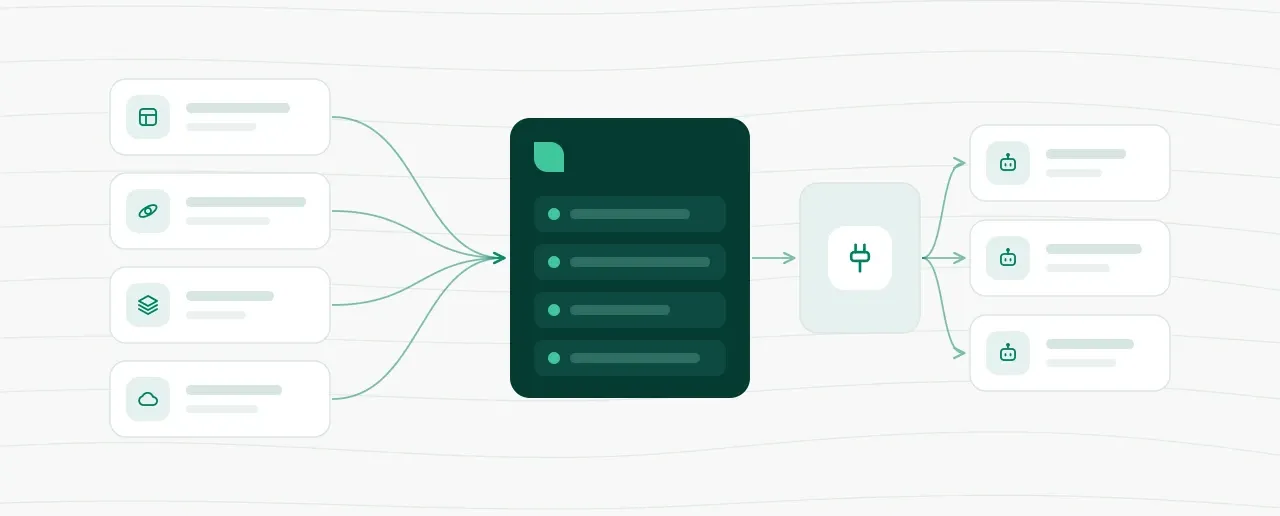
Before MCP, every AI application needed its own custom connector for every data source. One integration for John Deere, another for FieldView, another for your weather provider, rebuilt for each AI tool. MCP turns that N×M problem into N+M: each data source implements MCP once, and every AI client can use it.

Why agriculture needs MCP for farm data
Agriculture has one of the most fragmented data landscapes of any industry. A single operation may run a precision-ag platform, a weather station network, machinery telematics, a grain-storage system, a farm management information system (FMIS) and a set of spreadsheets. Each has its own API, schema and login. MCP gives AI agents one standard way to reach all of them.
The fragmentation isn't new. McKinsey's research on agtech adoption names fragmentation, the lack of a standard data architecture and poor interoperability between platforms as key barriers to scaling digital agriculture. What has changed is the cost of that fragmentation. AI agents can now reason across agronomic, weather, machinery and financial data at once, but only if they can reach it.
The industry is moving in this direction. FBN and Google are building an AI "context engine" so farm agents work from a full picture of each operation, and FBN has said that securing rich farm context is now a bigger constraint than software. AWS publishes guidance for multi-agent farm management assistants. Farmer co-ops are piloting AI assistants that pull together sensor, market, weather and cash-flow data.
For AgTech companies, the traditional route is expensive. In Qaltivate's experience building agricultural platforms, connecting just one satellite source plus one farm management system can take 3–6 months of engineering. We call that the integration tax. Multiply it by every OEM, FMS and data provider your customers use, and AI projects stall before they reach the field.
How MCP for agriculture works: from farm data to AI agent
An MCP setup for agriculture has three layers: farm data sources, an MCP server that exposes that data as tools and resources, and an AI client that discovers and calls those tools for the user. The agent picks which tools to call based on the question, then combines the results into an answer or action.
Here is the flow, step by step:
- Data sources. Farm management systems (John Deere Operations Center, Climate FieldView, CLAAS, xFarm, Cropwise), satellite imagery (Sentinel, Planet), soil data, weather feeds, ERP and IoT sensors.
- Ingestion and normalization. Raw data is pulled from each source and mapped to one consistent data model, so a field, a season and an application mean the same thing everywhere.
- MCP server. The normalized data is exposed as tools (list_fields, get_ndvi_timeseries, get_operations, get_weather_forecast) and resources (field maps, harvest summaries).
- MCP client. An AI assistant such as Claude, ChatGPT, Copilot, Cursor or a custom agent connects to the server and discovers the available tools automatically.
- Agent action. With the user's permission, the agent calls the right tools, combines the results and answers or triggers a workflow.
Here is an example. An agronomist asks: "Which of my fields had below-average NDVI last week, and is rain forecast before Thursday's planned spray?"
The agent would:
- call list_fields to get the grower's fields and boundaries,
- call get_ndvi_timeseries for each field and compare last week to the seasonal average,
- call get_operations to find the planned spray applications,
- call get_weather_forecast for those fields up to Thursday,
- then reply with a short list: three fields below average, one with 12 mm of rain forecast within the spray window, and a suggestion to reschedule.

AI agent farm data use cases
AI agents connected to farm data through MCP are most useful where people currently switch between several dashboards to answer one question. Here are the strongest early use cases:
Use case | Who uses it | Farm data involved | Outcome |
|---|---|---|---|
Agronomist copilot | Agronomists, crop advisors | Field health imagery, weather, operation history | Faster scouting priorities and spray-window decisions |
Multi-farm portfolio reporting | Co-ops, farm managers | Harvest, inputs, field boundaries across members | Plain-language reports in minutes instead of days |
Risk and supply estimation | Ag insurers, grain traders | Field-level yield history, imagery, weather | Better risk scoring and crop supply forecasts |
Sustainability and compliance | Food companies, co-ops | Applications, inputs, boundaries, practices | Faster carbon and regulatory reporting |
Developer productivity | AgTech engineering teams | Live field and operations data | Engineers query real data from Claude Code or Cursor while building |
The pattern is the same in each case. The value doesn't come from a smarter model. It comes from giving the model reliable access to the right farm data at the moment of the question.
MCP agriculture servers available today
The agriculture MCP ecosystem is young but growing quickly. Today it includes one major commercial data aggregator with an official server, a vendor-neutral platform with a built-in MCP server, community-built connectors for OEM platforms, and open-source servers for public datasets like weather, soil and agricultural statistics.
Server | Type | Data covered | Best for |
|---|---|---|---|
Leaf Agriculture MCP | Commercial, official | Unified API over John Deere, Climate FieldView, CNHi, AGCO, Trimble; 36 tools over Streamable HTTP | Teams already on Leaf's API |
AgriCore by Qaltivate | Vendor-neutral platform with built-in MCP server (early partner program) | European FMS (xFarm, Climate FieldView, CLAAS, Cropwise, John Deere), satellite, soil, weather, normalized into one data model | Co-ops, AgTech startups, insurers and traders that need clean, unified farm data |
John Deere Operations Center MCPs | Community-built | Fields, machines, operations via Deere's developer API | Developers experimenting with Deere data |
agriculture-mcp-server (open source) | Open source | Soil, crop weather, NASA POWER climate history, FAO statistics | Research, prototyping |
FAOSTAT MCP | Open source | UN FAO food and agriculture statistics | Market and country-level analysis |
Agri-weather and GAP agriculture MCPs | Open source | Agricultural weather, evapotranspiration, East Africa ensemble forecasts | Weather-driven advisory tools |
AgroMCP | Open-source template | Labor, costs, crops (reference schema) | Building your own server |
One gap stands out. According to ChatForest's review of agriculture MCP servers, no major equipment manufacturer has yet released an official MCP server. Everything for John Deere, Case IH and AGCO is community-built or provided by third parties. Most AgTech companies will need an aggregation or normalization layer rather than waiting for each OEM.
MCP is the interface. The data layer is the hard part.
MCP gives AI agents a standard way to connect to farm data, but it doesn't make that data consistent. If an agent connects directly to raw APIs, it receives conflicting schemas, units and field definitions, and it will give unreliable answers. Reliable agricultural AI needs a normalized, unified data layer underneath the MCP server.
Here is what goes wrong when you skip that layer:
- The same field exists three times. It has one boundary in John Deere Operations Center, a slightly different one in FieldView and a third in your satellite provider. The agent can't tell they are the same field.
- Units and seasons don't match. Kilograms per hectare against bushels per acre, calendar years against crop seasons, local against UTC timestamps.
- Every source names things differently. "Application", "spray job" and "as-applied" may all describe the same operation.
- Raw imagery isn't usable. Agents can't reason over cloudy, uncalibrated satellite tiles.
The result is an agent that sounds confident but contradicts itself, which is the fastest way to lose an agronomist's trust.
The architecture that works: Extract → Normalize → Unify → Contextualize
When Qaltivate builds AI-ready agricultural data platforms, the reference architecture has four stages:
1. Extract. Pull raw data from FMS APIs, OEM platforms, satellite feeds, soil databases and weather services.
2. Normalize. Map each source's own schema to one model for fields, boundaries and activities.
3. Unify. Use entity resolution based on geospatial overlap to match the same field across sources, producing one canonical record per field.
4. Contextualize. Apply crop-season logic, regional calibration and agronomic units, so the data means something to an agronomist and therefore to an agent.
Security, consent and farm data ownership with MCP
Connecting farm data to AI agents only works if farmers trust where their data goes. A secure agriculture MCP setup uses OAuth with consent the farmer can revoke, never exposes platform credentials to the agent, limits each tool to the minimum access it needs, and avoids permanently copying raw farm data.
Trust is a real barrier. In a 2020 Trust in Food survey of 393 farmers, 68% said production data should be protected as strictly as health information. University of Regina research found that only 16% of surveyed farmers believed producers benefit most from aggregated farm data. An AI layer that feels like a data grab will be rejected, however good its answers are.
Best practices for MCP for agriculture data:
- Use delegated OAuth, not shared passwords. The agent never sees FMS or OEM credentials.
- Make consent revocable and visible. Growers can see which apps and agents have access, and switch them off.
- Separate read and write tools. Start read-only. Anything that changes data, such as creating a work order or a prescription, should require a human to approve it.
- Minimize storage. Prefer short-lived caching over building another permanent copy of raw farm data.
- Log every tool call. Keep audit trails for compliance and for debugging agent behavior.
- Respect regional rules. For European operations, GDPR-compliant handling and multi-tenant access control are a baseline requirement.
- Respect regional rules. For European operations, GDPR-compliant handling and multi-tenant access control are a baseline requirement.
How to get started with MCP for agriculture data
The fastest way to start is to pick two or three high-value questions your users ask every week. Then connect only the data needed to answer them, normalize it, and expose it through a read-only MCP server. Expand to more sources and write actions once answers are accurate.
1. Inventory your data sources. List every FMS, OEM platform, imagery provider, sensor network and spreadsheet, and record who owns consent for each.
2. Choose 2–3 agent questions. For example, "Which fields need scouting this week?" or "Summarize inputs applied per member farm this season."
3. Decide whether to build or use a platform (see the table below).
4. Normalize before you expose. Don't put an MCP server directly on top of raw, conflicting APIs.
5. Launch read-only. Add write actions later, each one approved by a human.
6. Measure accuracy. Compare agent answers against agronomist ground truth before rolling out widely.
Approach | Time to first value | Pros | Cons |
|---|---|---|---|
Build your own MCP server on raw APIs | Months per source | Full control | You pay the integration tax for every source; normalization is on you |
Use a farm data aggregator's MCP | Weeks | Broad OEM coverage | Tied to one vendor's data model and pricing |
Use a normalized platform with built-in MCP (e.g. AgriCore) | Weeks | Vendor-neutral, unified field model, API + MCP from one layer | Best fit for European FMS coverage today; early partner stage |

Not sure where your data stands?
Qaltivate's Digital Readiness Assessment maps your sources, gaps and the fastest path to AI-ready farm data.
Conclusion: the plug is standard; the data behind it decides who wins
MCP is quickly becoming the standard way to connect AI agents to farm data, with support from every major AI platform. That part of the problem is effectively solved. The harder, more valuable work is making agricultural data consistent, unified and trustworthy enough for an agent to act on.
The AgTech companies, co-ops and agribusinesses that win will be the ones that fix the data layer first, then expose it through MCP.
Ready to connect your farm data to AI agents?
Join the AgriCore early partner program for a vendor-neutral, AI-ready farm data layer with a built-in MCP server, or talk to the Qaltivate team about your integration roadmap.