


Outgrower Management Software: Features & Build Guide
Running contract farming with hundreds or thousands of growers? This guide covers the eight modules of outgrower management software, from grower registration and input loans to mobile money payments and EUDR traceability, and how to choose between buying and building.

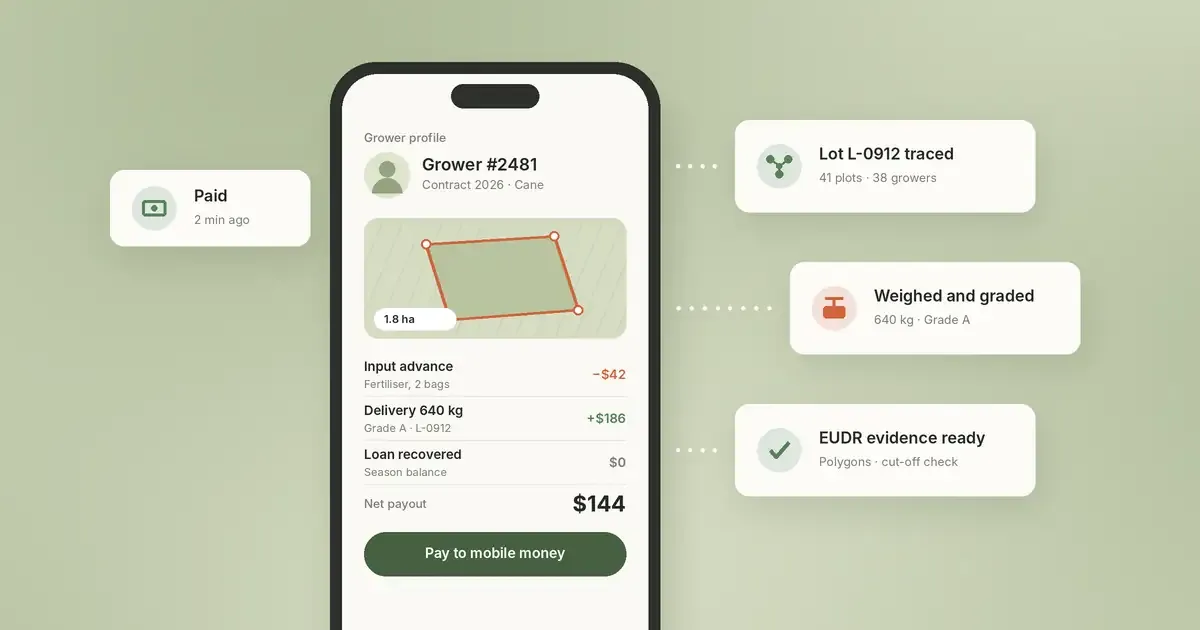
A sugar mill with 6,000 outgrowers does not have a farming problem. It has a data problem. Every season it hands out seed, fertiliser and cash advances to thousands of people it rarely sees, then has to weigh, grade, pay and recover loans from each of them in a few frantic weeks. When that runs on paper vouchers and Excel, money leaks, side-selling goes unnoticed and buyer audits turn into fire drills.
Outgrower management software fixes the data problem. This guide explains what it does, the eight modules that matter, how to prove traceability for the EU Deforestation Regulation (EUDR), and whether to buy a platform like Farmforce or SourceTrace or build your own.
What is outgrower management software?
Outgrower management software is a system that lets a processor, exporter or seed company run its contract farming programme end to end: register growers and map their plots, issue contracts and quotas, track input advances, record collections and grades, pay farmers and produce traceability evidence for buyers and regulators.
You will also see it called contract farming software, an outgrower management system, grower management software or a smallholder farmer management platform. The names differ; the job is the same. It connects three groups that usually work from separate spreadsheets:
- Field agents who register farmers, visit plots and log activities, often offline
- Operations and finance who issue inputs, run collection centres and pay growers, usually from an ERP
- Compliance and sales who answer buyer questionnaires, certification audits and EUDR due diligence
A good system gives all three the same farmer record, so a bag of cocoa or a tonne of cane can be traced back to a named grower, a mapped plot and the inputs used on it.
Who needs contract farming software, and when spreadsheets stop working
Outgrower schemes look different by crop, but the pain points repeat:
Business | Typical scheme | What breaks first |
|---|---|---|
Sugar mills | Thousands of cane growers on fixed delivery schedules, input and land-prep loans | Harvest scheduling, cane payment calculations, loan deductions Tobacco leaf companies |
Tobacco leaf companies | Growers on annual contracts with full input packages | Input recovery, side-selling, grade disputes, child-labour monitoring |
Seed companies | Seed multiplication contracts with strict isolation and inspection rules | Field inspection records, rejected lots, yield-per-hectare tracking |
Cocoa, coffee and rubber exporters | Smallholders aggregated through cooperatives or buying centres | Plot geolocation for EUDR, certification audits, premium payments |
Fruit, vegetable and spice processors | Growers on quotas tied to factory capacity | Quota tracking, quality grading, food-safety records (GLOBALG.A.P.) |
Spreadsheets usually hold up until about a few hundred growers. Past that, four things go wrong at once:
- Input leakage. Nobody can say which grower received which fertiliser, so loan recovery at harvest becomes guesswork.
- Side-selling. Growers sell contracted produce to a competitor at a better spot price, and you only notice when volumes fall short.
- Slow, disputed payments. Weights and grades are written on paper slips, re-typed at head office and paid weeks later in cash.
- No audit trail. A buyer or certifier asks for proof of origin and you spend days rebuilding it from field notebooks, a classic farm data management failure. The EUDR raised the stakes. From 30 December 2026, large and medium operators placing cocoa, coffee, rubber, soy, palm oil, cattle or wood on the EU market must show the geolocation of every plot the commodity came from. If your grower data lives in Excel, that evidence does not exist in a usable form.
The 8 modules every outgrower management system needs
These modules follow the season: register, contract, finance, farm, collect, pay, prove. Each one feeds the next, which is why bolting together separate tools rarely works.

Grower registration and plot mapping
Everything starts with a clean farmer record. Field agents register each grower on a phone: name, national ID or phone number, photo, household details, bank or mobile money account, cooperative or group, and consent for data use. Good agricultural data collection at this stage saves months of cleanup later.
Then they map the plots. For EUDR and most sustainability programmes you need GPS coordinates, and for larger plots a polygon walked around the boundary. Store each plot as a separate record linked to the grower, with crop, area, planting date and land tenure. One grower often farms three or four plots, and only some of them may be under contract.
What to look for:
- Duplicate detection by phone, ID and photo, so the same farmer is not registered twice under different spellings
- GPS point and polygon capture with accuracy readings, plus area calculated from the polygon rather than self-reported
- Deforestation risk checks against satellite forest-cover layers at registration, not months later
- Offline capture with sync, because most plots have no signal
Contracts and quotas
The contract defines what you are buying: crop, variety, expected volume or area, quality specification, price formula and delivery window. Your contract farming software should store a digital contract per grower per season, ideally signed on the agent's phone with a photo or signature.
Quotas matter most where factory capacity is fixed. A tomato or chilli processor needs to know, week by week, how much contracted volume is coming. The system should compare estimated yield per plot against the quota and flag growers who are likely to under-deliver, which is often the first sign of side-selling. The same data feeds demand and intake planning at the factory.
Input advances and loan recovery
This is where most schemes lose money. Seed, fertiliser, chemicals, ploughing services and cash advances go out on credit, to be recovered from the harvest.
A proper module works like a small loan book:
- An input catalogue with prices, units and season
- Issue vouchers linked to the grower and plot, recorded at the warehouse or by the field agent, with the grower confirming receipt (signature, PIN or SMS)
- A running grower account showing every advance, interest or service fee and repayment
- Automatic deduction at payment time, with rules for partial recovery, carry-over to next season and group liability
- Credit limits per grower based on area, past yield and repayment history
When this is connected to collections, the question "how do food processors track inputs given to contracted growers?" has a simple answer: every input is a line on the grower's account, and every delivery pays it down. If you plan to work with banks or lenders on grower credit, see our guide to agricultural fintech and farm finance.
Field agent mobile app (offline-first)
Field agents are the eyes of the scheme. Each may cover 100 to 300 growers. Their mobile app needs to do four jobs well: registration and mapping, farm visits (crop stage, pest problems, yield estimates, photos), training attendance, and input distribution.
Offline-first is not optional. The app must work for days without signal, store data on the device, and sync when it reaches coverage, resolving conflicts without losing records. Other must-haves:
- Task lists and visit schedules pushed from head office
- Forms that the operations team can change without a new app release
- Low-end Android support, because agents rarely carry flagship phones
- Local languages and icon-led screens for agents with limited literacy
- GPS stamps on every visit, so managers can confirm visits actually happened
Harvest collection and grading
Collection is where weight, quality and money meet. At a buying centre or mill weighbridge, the clerk identifies the grower (by card, QR code or phone number), records gross and net weight, moisture or sugar content, and grade, and prints or texts a receipt.
Good systems connect directly to digital scales or weighbridges through IoT integration to remove re-typing, apply grade-based price tables automatically, and assign every delivery a lot or batch ID. That ID is what makes traceability possible later. Disputes drop sharply when the grower gets an SMS with weight, grade and value within minutes of delivery.
Payments and mobile money
Paying thousands of smallholders in cash is slow, risky and expensive. The software should calculate each grower's net payment (gross value minus input deductions, levies and fees) and pay it out digitally.
In most outgrower regions that means mobile money. Mobile money now has 2.3 billion registered accounts worldwide, with more than $2 trillion moving through wallets in 2025. A payment module should:
- Integrate with mobile money operators (M-Pesa, MTN MoMo, Airtel Money, Orange Money) and bank transfer rails through their bulk payment APIsRun a maker-checker approval before each payment batch
- Reconcile every transaction, retry failures and flag mismatched account names
- Send each grower a payslip by SMS showing how the amount was calculated
This is also the point where the system can offer more than payments: savings, input credit, insurance or advance payment against expected harvest. That is embedded finance, and it turns the outgrower platform from a cost centre into a grower retention tool.
Traceability and EUDR evidence
Traceability is the chain that links a finished product back to farms. In an outgrower system it runs: plot → grower → delivery → lot → warehouse/process batch → shipment. If each step carries an ID, you can answer "which farms is this container from?" in seconds, the same principle behind supply chain tracking software.
For EUDR, the system needs to store, per shipment:
- Geolocation (points or polygons) of every plot that contributed
- Evidence that those plots were not deforested after the cut-off date of 31 December 2020
- Proof that production was legal in the country of origin (land rights, labour, permits)
- A risk assessment and mitigation record
- The data needed for the due diligence statement or declaration in the EU information system
The hard part is mass balance. Cocoa beans from 400 growers get mixed in one warehouse. Your software must track which deliveries went into which lot so you can list every contributing plot, not just the ones you hope were used. For the wider picture, read our guide to traceability in agriculture and our overview of how software supports EUDR compliance.
Buyer and certification reports
The last module turns field data into answers. Typical outputs:
- Supplier lists and farm maps for buyer due diligence
- Rainforest Alliance, Fairtrade, organic and GLOBALG.A.P. internal inspection records
- Child labour and social monitoring indicators
- Premium payment reports showing what each certified grower received
- Operations dashboards: deliveries vs quota, loan recovery rate, agent productivity, built on solid agriculture analytics
Build these as exports your buyers can actually load (CSV, GeoJSON, API) rather than PDFs. A buyer asking for 2,000 plot polygons does not want a document.
Buy or build: Farmforce, SourceTrace or custom outgrower software?
There is no single "best software for managing contract farmers". The right choice depends on how standard your scheme is and how much of your business logic lives in it.
Off-the-shelf platforms are the fastest route. Farmforce, which began as a Syngenta Foundation initiative, is a subscription platform for farmer data, field activities and compliance; as of February 2026 it reported around 1.4 million farmers and 1.1 million mapped fields across 32 countries. SourceTrace is a SaaS provider covering farm management, advisory, traceability, certification and financial services for smallholder supply chains. Other options include ERP add-on outgrower modules and enterprise agri platforms. For a wider market view, see our ranking of farming software companies.
Custom software is built around your contracts, price formulas, loan rules and integrations, and you own the code and the data model.
Factor | Off-the-shelf platform | Custom build |
|---|---|---|
Time to first season | Weeks to a few months | 4 to 9 months for a full MVP |
Upfront cost | Low; setup and training fees | Higher; design and development |
Running cost | Per-farmer or per-user subscription that grows with scale | Hosting and maintenance; flat as grower numbers grow |
Fit to your price and loan rules | Configurable within the vendor's model | Exact |
ERP, weighbridge, mobile money integration | Depends on vendor connectors | Built to your stack |
Data ownership and exports | Governed by contract | Full |
Embedded finance and new products | Limited to vendor roadmap | Yours to add |
Buy if you run a fairly standard scheme, need to be live this season, have fewer than a few thousand growers, or mainly need certification and EUDR data collection.
Build if any of these are true:
- Your pricing, grading or loan recovery rules are complex and give you a commercial edge (sugar cane payment by sucrose content, tobacco grade tables, multi-season input credit)
- You need tight system integration with SAP, Dynamics or Odoo, weighbridges and several mobile money operators
- Per-farmer licence fees at 20,000 or 100,000 growers would exceed the cost of owning the system
- You plan to offer credit, insurance or savings to growers and want control of that product
- You run several crops or countries and need one data model across all of them, which calls for platform architecture built for scale
A common middle path: start on a platform for registration and EUDR mapping, then build custom modules for finance, payments and collections once your processes are clear. Make sure your contract lets you export all farmer, plot and transaction data in open formats so that path stays open; otherwise you pay the integration tax later.
How to build outgrower management software
A custom outgrower management system has three layers: an offline mobile app for agents and collection clerks, a web back office for operations, finance and compliance, and an integration layer that talks to your ERP, scales, mobile money operators and satellite data.
Architecture
- Mobile app (Android first): offline database on the device, background sync, GPS and polygon capture, camera, Bluetooth scale and printer support, QR or NFC grower cards
- Back office (web): grower and plot registry, contracts, input catalogue and grower accounts, collection and grading, payment batches, reports and dashboards, role-based access
- Core services: a farmer registry as the single source of truth, a ledger for advances and repayments, a lot and batch service for traceability, a rules engine for prices, grades and deductions
- Integrations: ERP (SAP, Microsoft Dynamics, Odoo) for stock and accounting; mobile money and bank bulk payment APIs; SMS and USSD gateways; satellite forest-cover data for deforestation checks; EU information system exports for EUDR
- Data and security: encrypted storage, audit logs on every change to money or plot data, consent records, and cloud hosting that scales while meeting local data protection law
If your outgrower data must also flow into logistics, warehousing and sales, plan it as part of wider agriculture supply chain software rather than a standalone tool.
A phased roadmap
- Discovery (3 to 6 weeks). Map the season end to end with field agents, warehouse clerks and finance. Write down every price formula, grade table and deduction rule. Decide what the ERP owns and what the outgrower system owns.
- MVP (3 to 5 months). Grower registration and plot mapping, contracts, input issue and grower accounts, and the offline agent app. Pilot with one region or one collection centre.
- Collections and payments (2 to 3 months). Weighbridge or scale integration, grading, lot IDs, net payment calculation and mobile money payouts with reconciliation.
- Traceability and compliance (2 to 3 months). Lot-to-shipment linking, deforestation risk checks, EUDR data packs, certification and buyer reports.
- Scale and extend. Roll out to all regions, add yield forecasting, grower credit scoring, insurance or savings products.
Timelines vary with the number of integrations and how settled your processes are; our agriculture app development cost guide breaks down the budget side. The biggest cause of delay is not code; it is business rules that nobody has written down.
Practical tips from real deployments
- Clean your grower list before migration. Expect duplicates, missing phone numbers and plots with no coordinates.
- Design for the worst phone and the weakest signal, not the demo device in head office.
- Train agents in the field, in their language, and pay attention to their feedback in the first month.
- Give growers something back: SMS receipts, payslips and visibility of their loan balance build trust and reduce disputes.
- Treat plot polygons as living data. Re-map when plots change and keep the history; auditors will ask.